Blog

  • 5 Ways to Improve Call Center Onboarding Without Slowing Down Ops

    5 Ways to Improve Call Center Onboarding Without Slowing Down Ops

    5 Ways to Improve Call Center Onboarding Without Slowing Down Ops

    New Reality: AI Is Redefining Call Center Onboarding
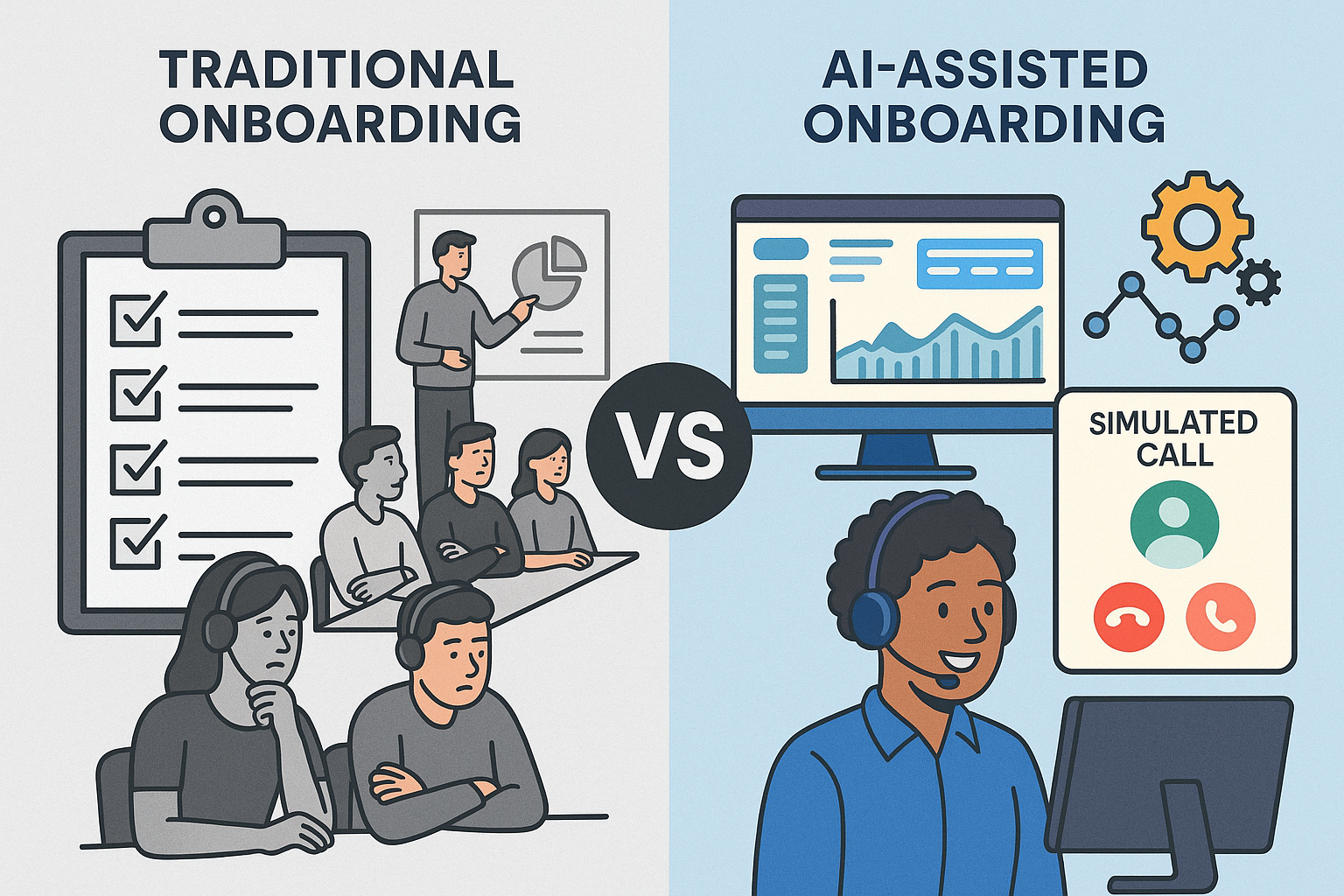
    Side-by-side comparison of traditional and AI-assisted call center onboarding. Left: bored agents in a classroom with checklists and a whiteboard. Right: smiling agent using a headset in front of a dashboard with simulated call and automation icons.
    Contrasting outdated onboarding methods with modern AI-enhanced training in call centers.

    Today’s contact center leaders face a balancing act: ramp agents faster, improve call quality, and avoid disrupting daily operations.

    But traditional onboarding hasn’t kept up. Lengthy classroom sessions, inconsistent roleplay, and slow feedback loops are still common — even though they rarely translate into better performance.

    And that gap is costly. According to McKinsey, high-performing agents are up to 3x more productive than low performers. Meanwhile, ICMI reports that 62% of contact centers take more than two months to fully onboard a new agent. That’s too long.

    The opportunity? AI-powered onboarding that lives in the back office. You can safely optimize training where it won’t affect customers — giving your team faster ramp times, better data, and more control.

    1. Identify High and Low Performers Early
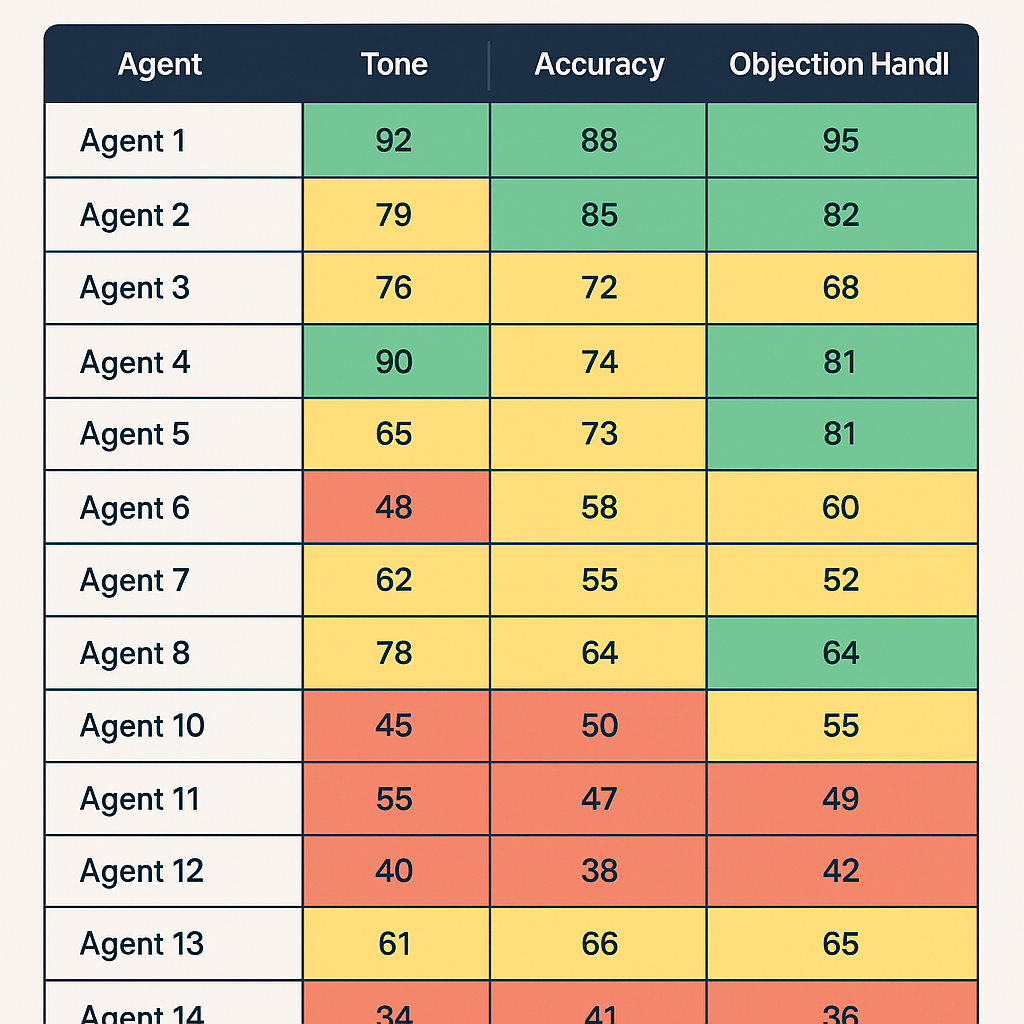
    A training dashboard displaying mock call performance scores for 14 agents across three categories: Tone, Accuracy, and Objection Handling. Each score is color-coded with green (top performers), yellow (average), and red (low performers).

    The earlier you can separate high-potential hires from poor fits, the better. Early training is your chance to assess not just skills, but coachability — a leading indicator of long-term success.

    Many leaders hesitate to cycle out low performers too soon. But dragging them through onboarding can waste thousands in time and wages, while slowing your coaches down.

    Action Tip:

    In the first week, score mock calls using a rubric with clear categories: product accuracy, tone, active listening, and objection handling. Use this data to tag coachable agents for fast-tracking, and move on quickly from those who aren’t progressing.

    2. Track Performance Before the First Real Call
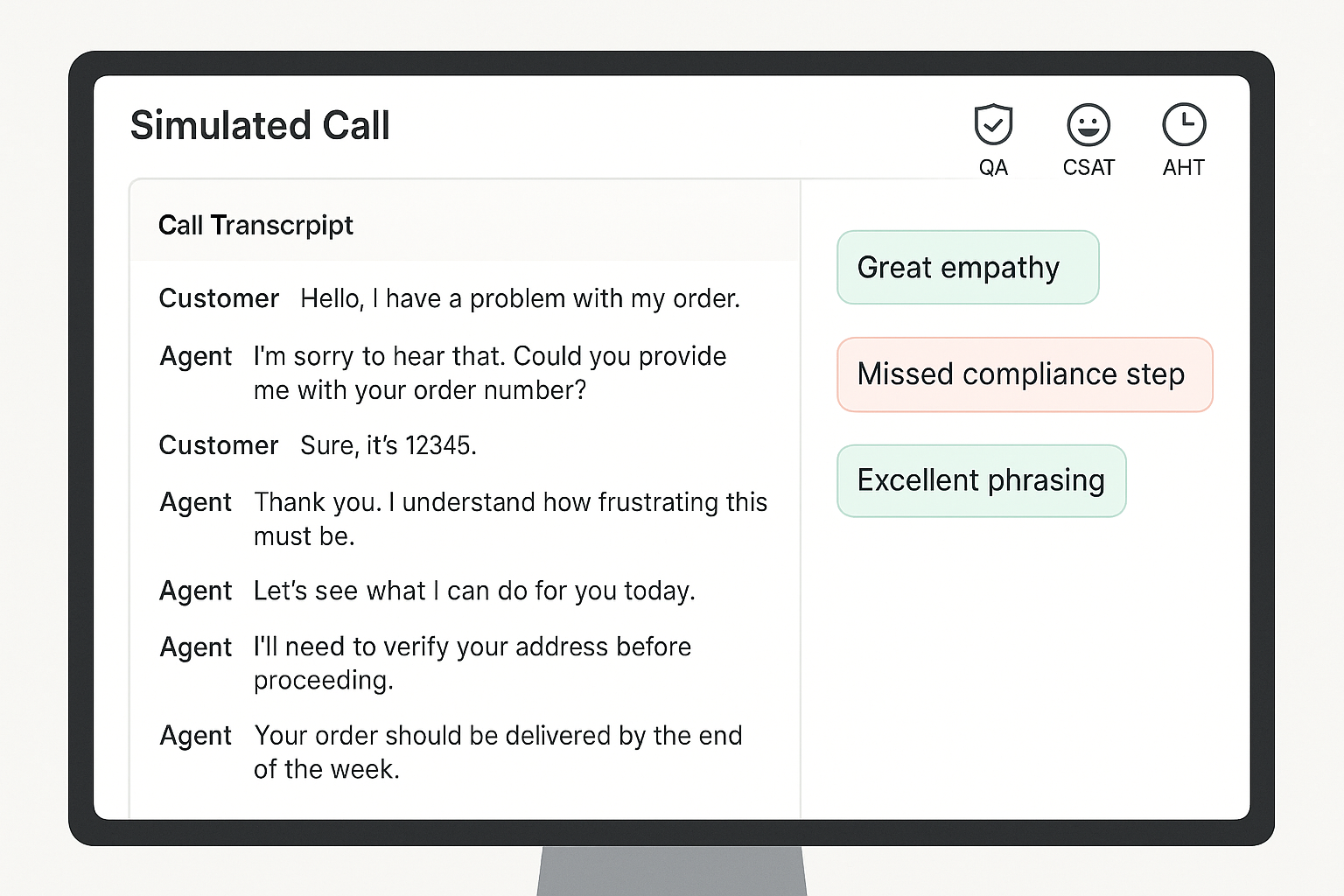
    A computer screen displaying a simulated customer service call interface with a call transcript on the left and feedback annotations like “Great empathy” and “Missed compliance step” on the right, along with QA, CSAT, and AHT icons at the top.

    Your first live call shouldn’t be the first time you assess an agent’s skills.

    Without early benchmarks, it’s impossible to know who’s ready — or what good looks like. That’s why simulated performance tracking is key.

    Leading teams are using AI-powered roleplay and simulation to measure call handling, QA adherence, and even mock CSAT before agents hit the floor. This reduces the chance of bad first impressions with customers.

    Action Tip:

    Use virtual customers to simulate key scenarios during onboarding. Track how each rep performs on scripted calls, objections, compliance, and empathy. Benchmark performance across day 1, week 1, and week 4.

    3. Make Practice Safe, Frequent, and Feedback-Rich
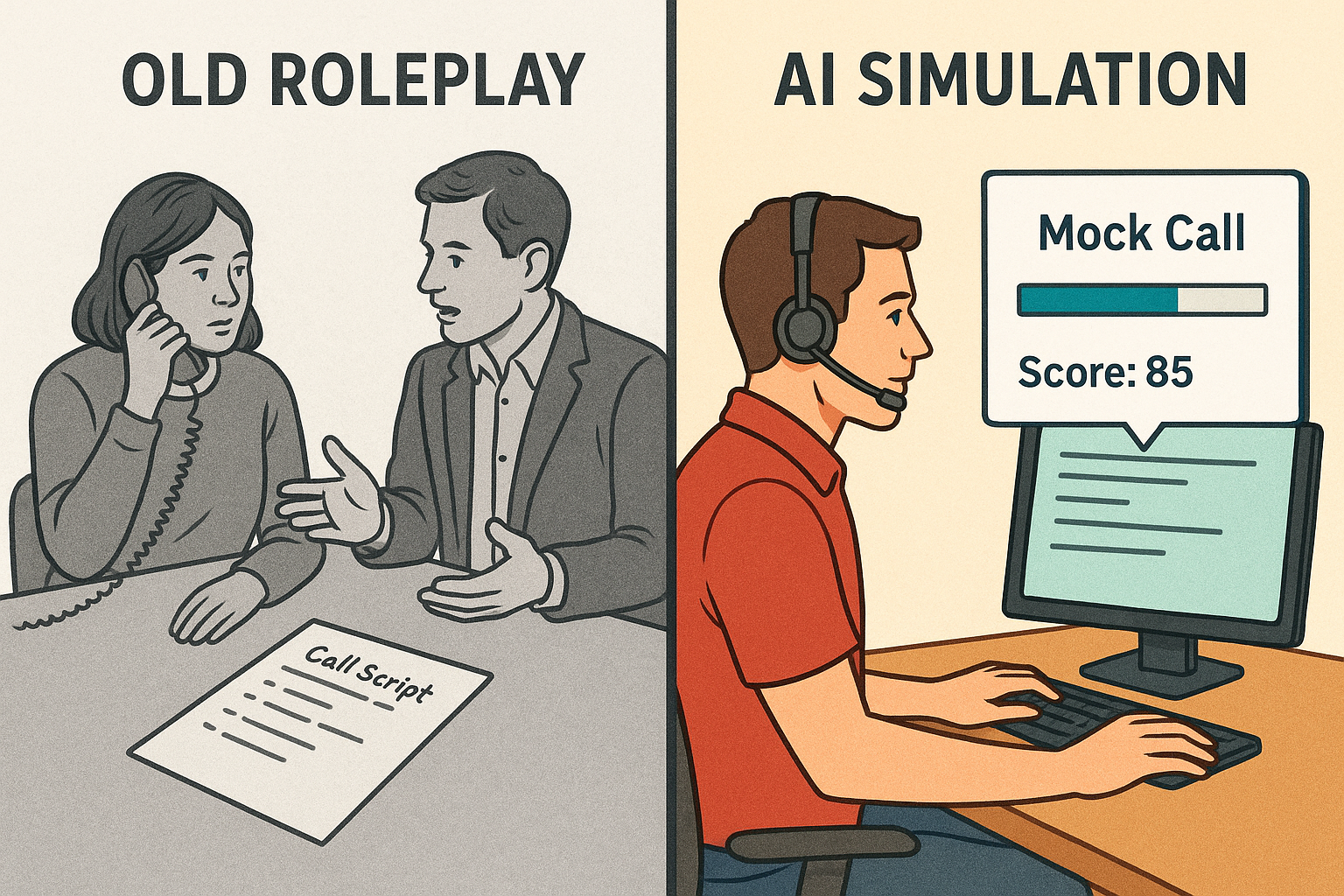
    Split-screen illustration comparing traditional call roleplay and modern AI simulation. Left side shows two people practicing a call with a phone and call script; right side shows a person at a computer with a headset, mock call progress bar, and a score of 85.
    From manual practice to measurable progress: how AI is transforming call training.

    Live roleplays are useful, but they’re often inconsistent. One coach might give thorough feedback while another lets agents skate by. Worse, they’re time-consuming.

    Practice needs to be low-risk, repeatable, and paired with instant feedback. AI makes this possible. Simulated calls can happen anytime, anywhere, and every interaction can be scored against consistent standards.

    Action Tip:

    Replace ad hoc roleplay with structured simulations powered by virtual customers. Layer in automated scoring and feedback, so agents always know what to fix. Aim for 3–5 short simulations per module, with a minimum passing score required to move on.

    4. Optimize for Your Fastest Rampers
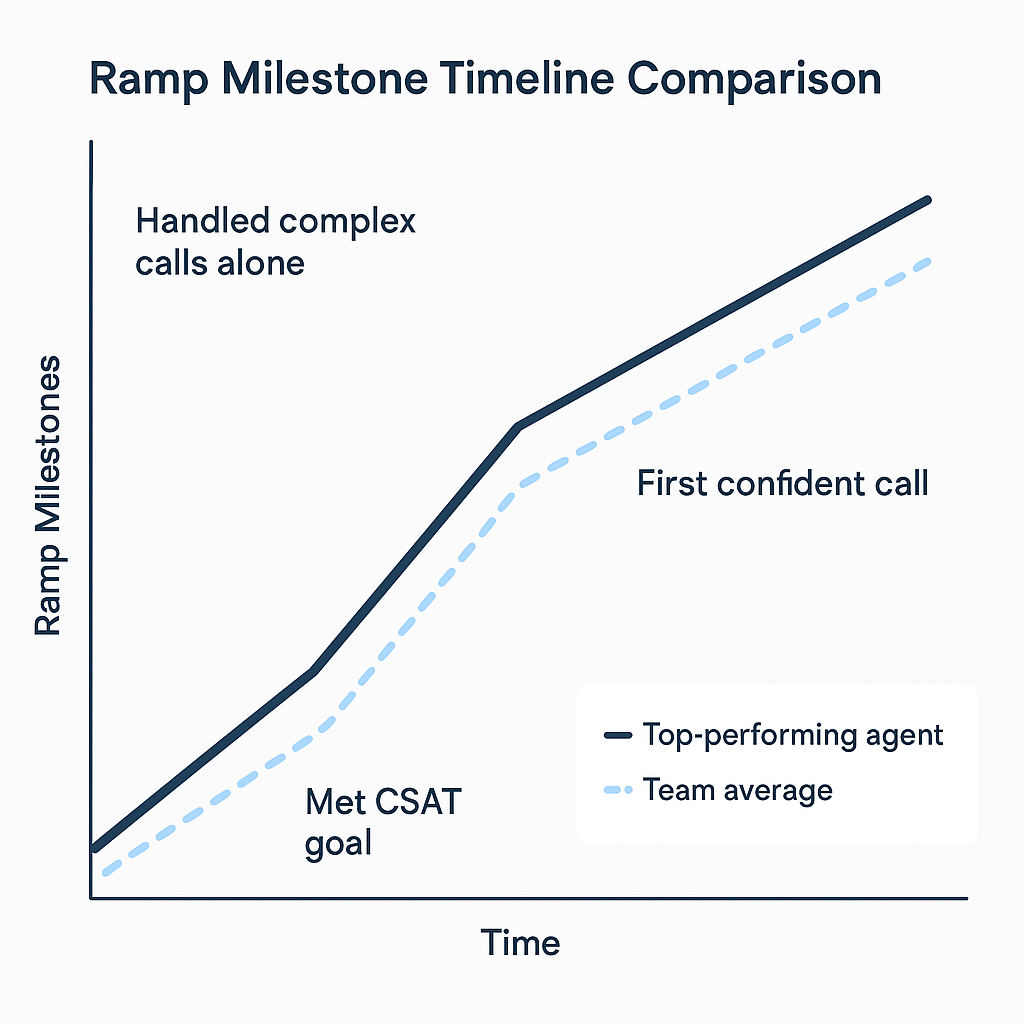
    A 2D digital line graph comparing the ramp-up timeline of a top-performing agent versus the team average. The graph shows three milestones—“Met CSAT goal,” “First confident call,” and “Handled complex calls alone”—with the top performer reaching each milestone earlier than the team average.

    A Salesforce study found that shortening ramp time by just 10% led to a 12% increase in agent productivity. Source

    Most onboarding is designed for the average hire. That drags down your timeline.

    Instead, study your fastest-ramping agents and reverse-engineer their path. When did they become proficient? What practice helped them most? What milestones did they hit and when?

    This approach lets you rebuild onboarding around outcomes — not activities.

    Action Tip:

    Track your top performers’ onboarding journey across three milestones:

    1. Time to confident first call
    2. Time to hit CSAT / QA targets
    3. Time to independent handling of complex scenarios

    Use those patterns to redesign your onboarding flow around results, not just schedules.

    5. Shift from “One and Done” to Ongoing Micro-Coaching

    Most agents regress after onboarding if they don’t get regular coaching. But teams are often too busy to keep supporting new hires beyond week one.

    That’s where micro-coaching comes in. By pushing small, targeted refreshers based on real call data, you can keep agents sharp without adding to your team’s workload.
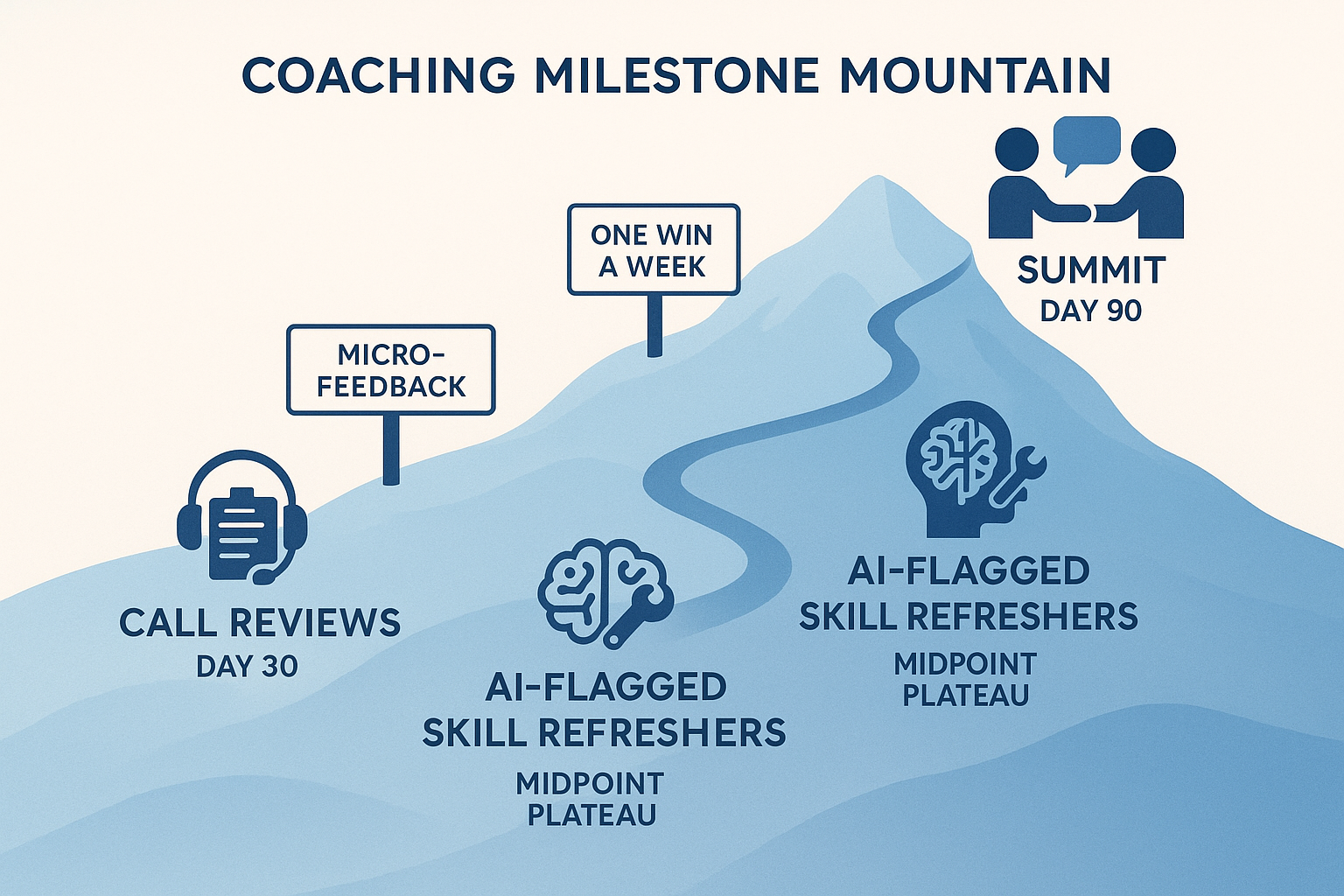
    A stylized mountain trail map showing a 90-day coaching journey with three key milestones: Call Reviews at Day 30, AI-Flagged Skill Refreshers at Day 60, and Peer Coaching at Day 90, along a blue gradient mountain path.
    A visual metaphor for a 90-day coaching journey, with milestones marked along a rising mountain path: Call Reviews (Day 30), AI-Flagged Skill Refreshers (Day 60), and Peer Coaching (Day 90).

    Action Tip:

    Create a 30/60/90 day plan that combines live call reviews with 5–10 minute refreshers. Use AI to flag skill gaps and trigger the right micro-lesson. Consider peer coaching too — it boosts engagement and reinforces best practices.

    Call Center Onboarding Optimization Checklist

    Here’s your quick-start reference for streamlining onboarding without sacrificing quality.

    Agent Evaluation (Week 1)

    Score every agent on coachability using mock or simulated calls
    Use a rubric: tone, product accuracy, objection handling
    Tag high-potential agents for fast-tracking
    Part ways early with non-coachable hires

    Performance Benchmarks

    Set QA, CSAT, and AHT targets for day 1, week 1, and month 1
    Use simulated environments to pre-test before live calls
    Track new-hire performance in a shared dashboard

    Training Program Design

    Focus on practice and feedback over slide-heavy sessions
    Use AI-driven simulations instead of manual roleplays
    End each module with a pass/fail assessment or mock scenario

    AI & Automation Integration

    Deploy Intelligent Virtual Customers for scalable mock calls
    Automate scoring and feedback to free up coaches
    Use performance data to trigger just-in-time coaching

    Ongoing Reinforcement

    Build a 30/60/90 day roadmap with checkpoints and refreshers
    Push short, targeted lessons based on call performance
    Enable peer reviews and shared call feedback

    Final Thoughts: Onboarding Doesn’t Have to Be a Bottleneck

    Modern onboarding doesn’t have to mean slowing down operations or risking the customer experience.

    Training lives in the back office. That’s where innovation can thrive — and where AI can safely support your team.

    If you’re ready to reduce ramp time while giving your agents more practice, more feedback, and a smoother path to proficiency, TrueCX can help.

    Explore how TrueCX’s Intelligent Virtual Customers enable faster, smarter onboarding — without slowing down your floor.
    Keep Reading

  • What Effective Call Center Training Looks Like in 2025

    What Effective Call Center Training Looks Like in 2025

    What Effective Call Center Training Looks Like in 2025

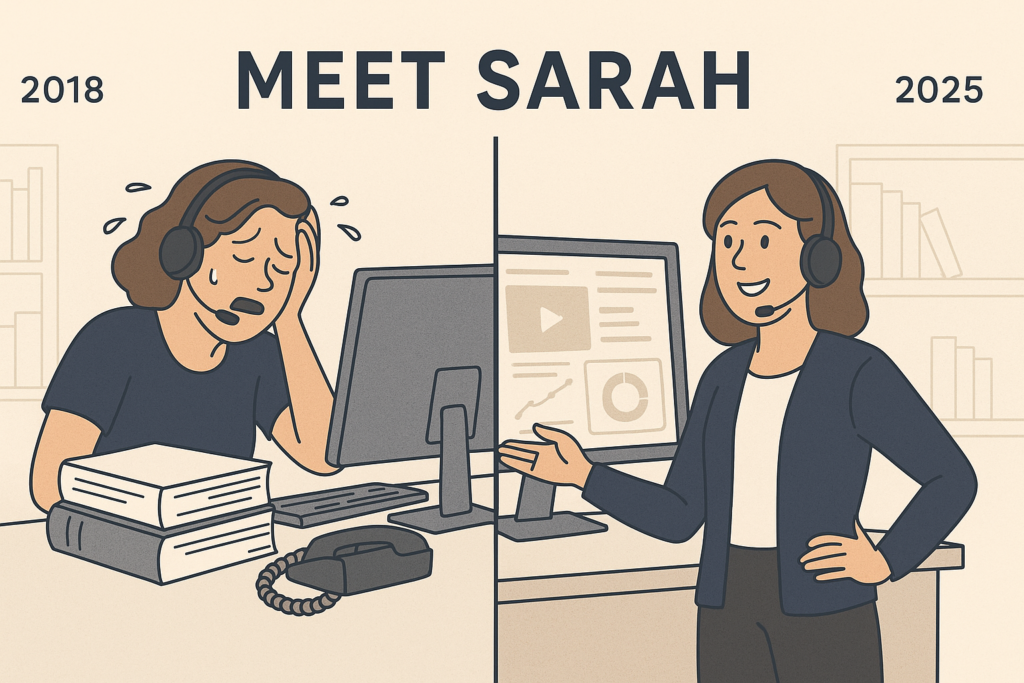
    Side-by-side illustration of Sarah in 2018 overwhelmed during traditional training, and in 2025 confidently using AI tools.

    Sarah used to dread her first week on the job.

    Back in 2018, fresh out of school and eager to prove herself, she joined a call center team for a fast-growing tech company. Day one was eight hours of PowerPoints. Day two was shadowing agents.

    Day three? A role-play that made her stomach churn—pretending to be a furious customer while a coworker stumbled through a mock call. None of it felt real. None of it prepared her for what happened when she finally picked up a call from an actual angry customer.

    Fast forward to 2025: Sarah is now a team lead. And the training she gives her new hires? It’s unrecognizable from what she experienced. Her agents are onboarded in interactive, AI-powered simulations—real-time, emotionally dynamic, customer-like conversations. They practice tough calls on day one, make mistakes without fear, and get feedback instantly. No more stage fright. No more guesswork. Just smart, safe, skill-building from the start.

    So what changed?

    Training in 2025 Is an Entirely Different Game

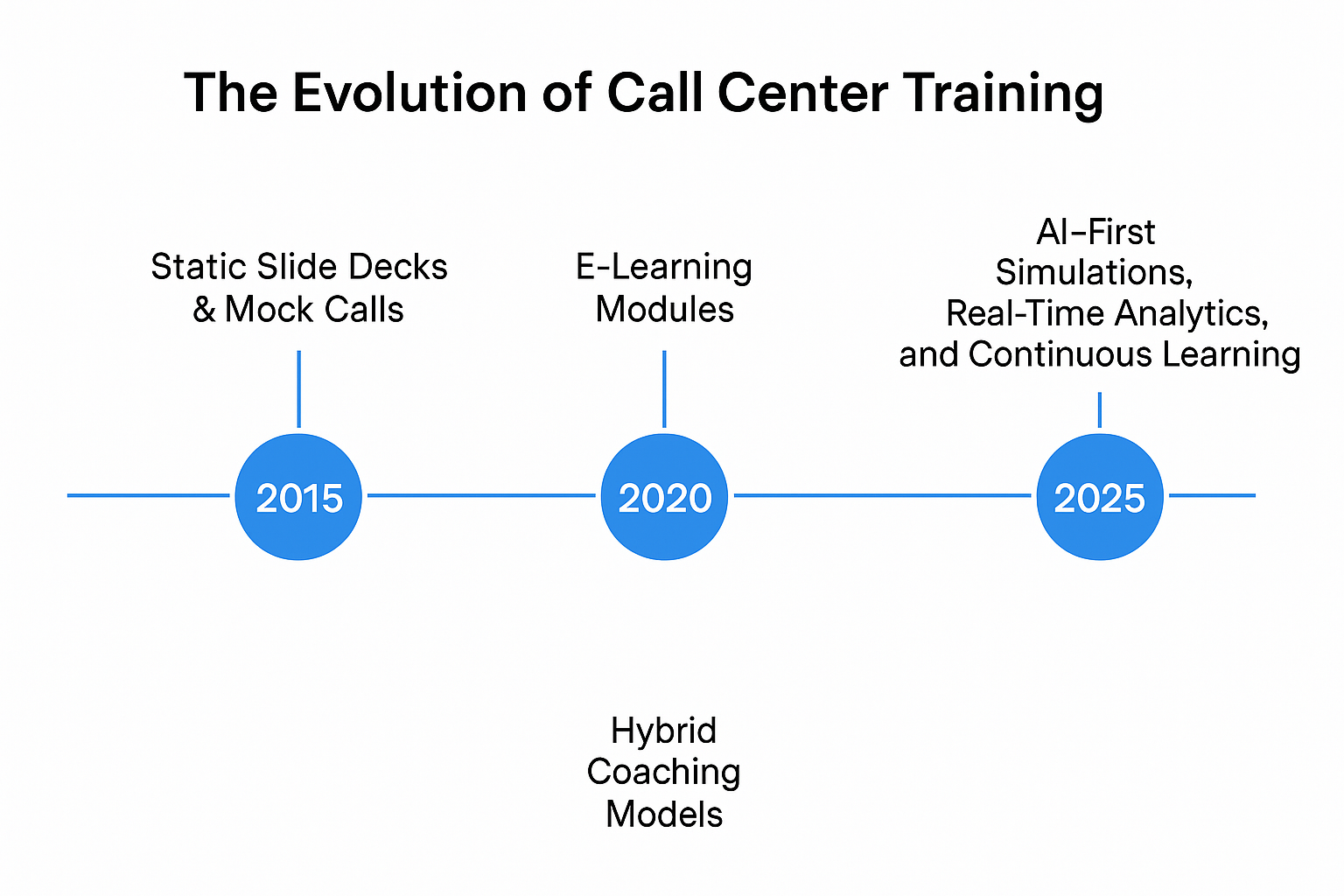
    Horizontal timeline showing key shifts in call center training: 2015’s static slide decks, 2020’s e-learning modules, and 2025’s AI-first tools.
    A decade of transformation in training methodologies.

    Call center training has gone through a transformation—and not a quiet one. Between rising customer expectations, hybrid workforces, and the explosion of AI, training teams have had to throw out the old playbook. The best ones haven’t just adapted; they’ve reimagined.

    Remember the mock calls Sarah had to sit through? In 2025, they’re all but extinct. Top-performing contact centers are investing in AI-first solutions that mimic real conversations with remarkable accuracy. Agents train with virtual customers who interrupt, escalate, ask unpredictable questions—just like a real call. But here’s the difference: they can do it again and again, until they get it right.

    Why the Old Way Stopped Working

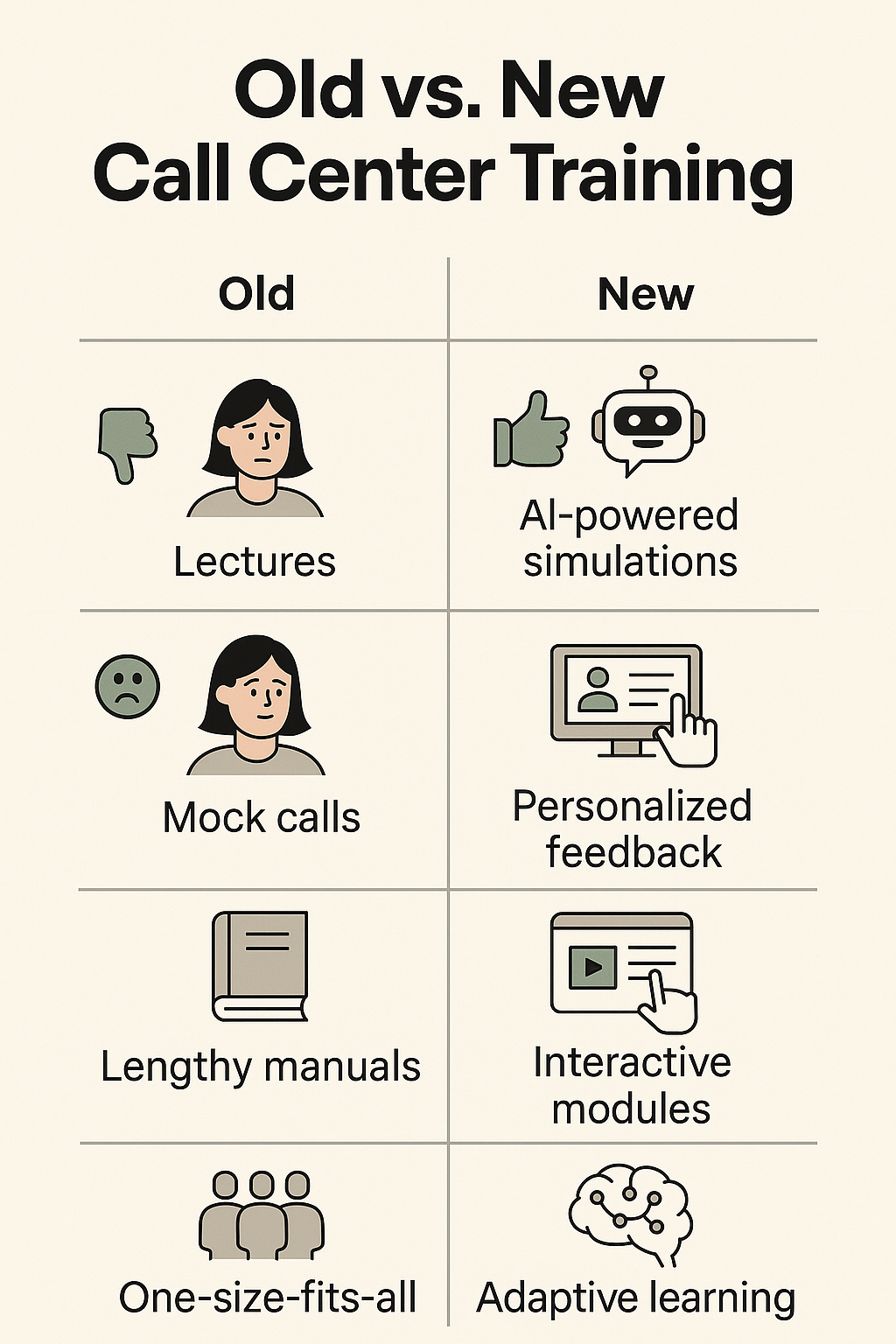
    Side-by-side icons showing old training methods like lectures and mock calls versus new methods like AI simulations and adaptive learning.

    Classroom lectures, static LMS modules, and role-play games weren’t just boring—they were ineffective. They didn’t stick. They didn’t scale. They didn’t support performance after onboarding. In fact, high turnover and low confidence often started in training.

    Sarah still remembers the panic she felt her first week taking live calls. “I knew the script, but I didn’t know how to think on my feet,” she says. “I didn’t know how to de-escalate, or what to do when a customer interrupted me mid-sentence.”

    She wasn’t alone. Research from McKinsey shows that customer care leaders now rank “retaining and developing talent” as a top-three priority. And for good reason: replacing a single agent can cost upwards of $6,500.

    The AI Training Revolution

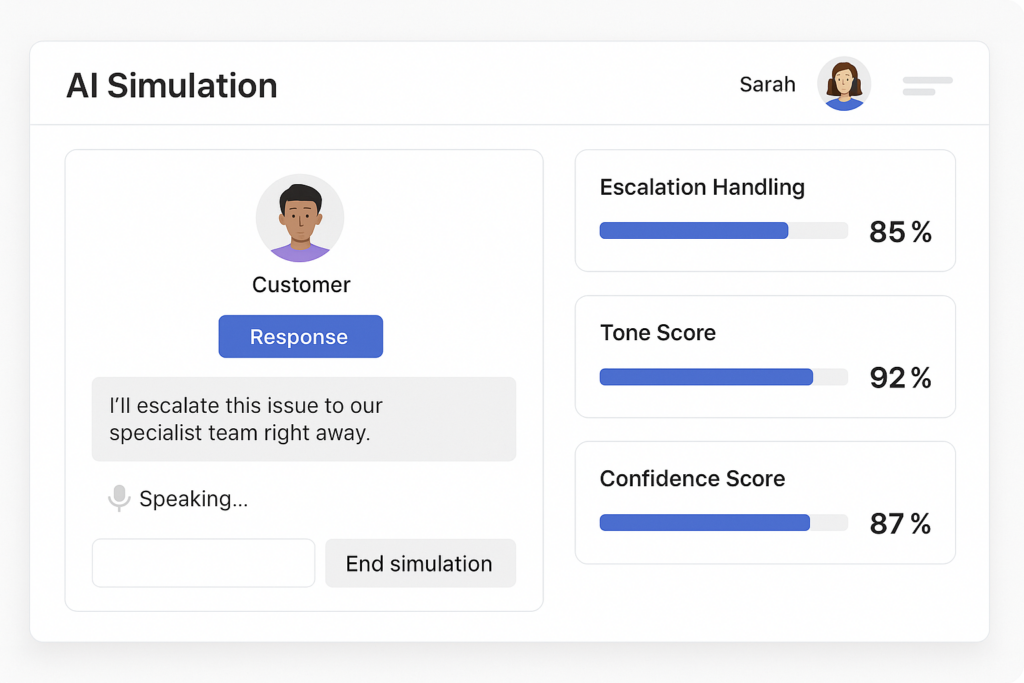
    Today, Sarah’s new hires train inside an AI simulation tool – think of it like a flight simulator, but for customer conversations. The AI listens, reacts, pivots, and escalates. It’s not just “choose-your-own-adventure.” It’s emotionally intelligent, using sentiment analysis to mirror customer moods and throw real-world curveballs.

    Stylized dashboard mockup showing a customer simulation and metrics like escalation handling, tone score, and confidence score.
    Sarah’s agents train with AI simulations before taking a live call.

    And it works. These simulations cut ramp-up time in half. According to Gartner, 80% of support organizations will use generative AI by the end of 2025. Some are already using it to simulate customer conversations, personalize learning paths, and even coach agents in real-time.

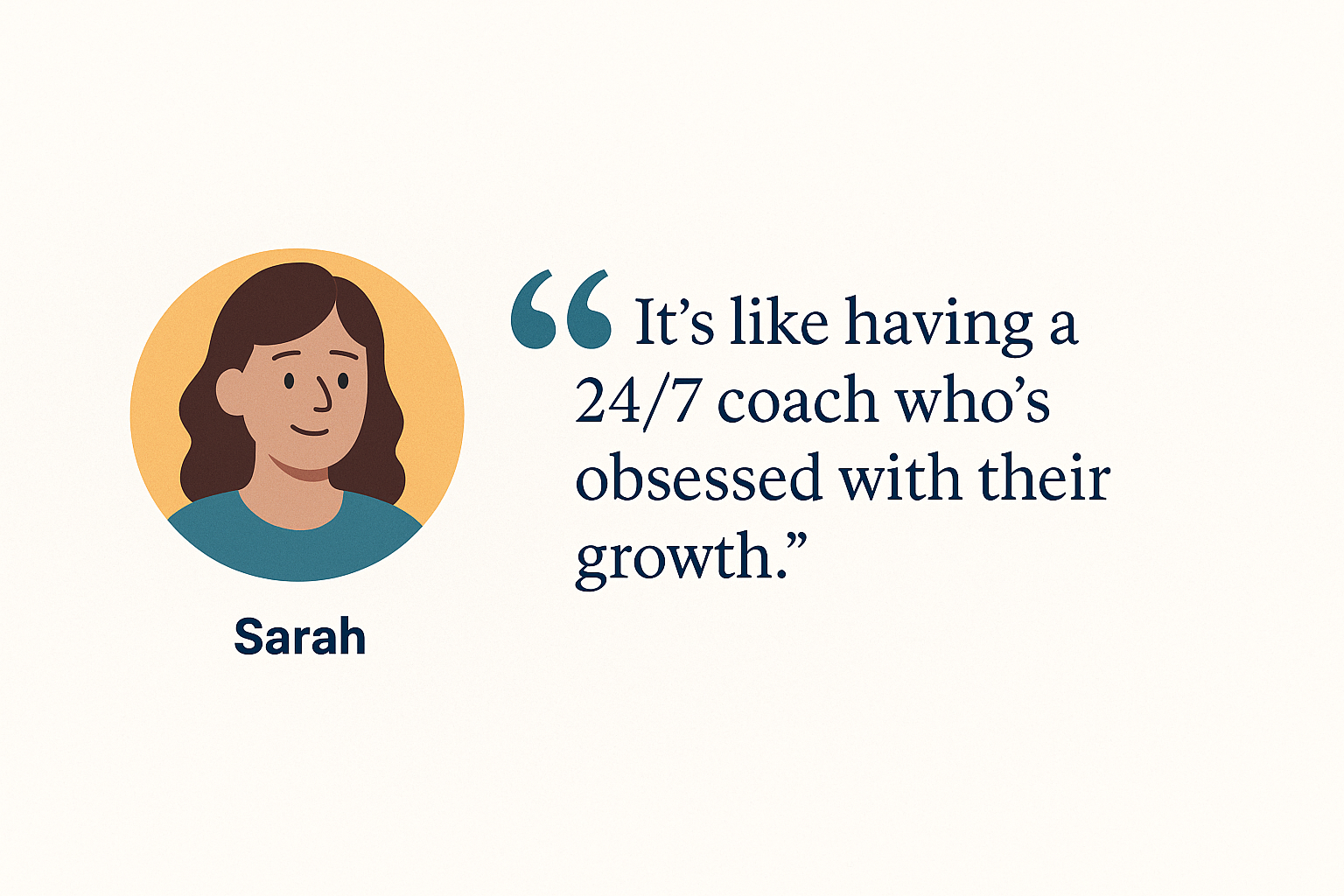
    Illustrated quote card showing Sarah with the quote: “It’s like having a 24/7 coach who’s obsessed with their growth.”

    Sarah’s favorite part? The data.

    “After every simulation, the system shows agents what they did well, what triggered a negative response, and what they could say differently. It’s like having a 24/7 coach who’s obsessed with their growth.”

    ROI That Talks to the C-Suite

    This isn’t just about cool tech. It’s about results. According to Accenture, organizations that invest in strong training programs see an average of 353% ROI. And companies using AI-powered training tools are reporting 20% faster handle times and 15% boosts in CSAT.

    Sarah’s own center has seen a double-digit drop in first-year turnover since switching to AI-first training. Customers are happier. Agents are sticking around. And when the CFO asks for numbers, Sarah doesn’t blink—because they’re all moving in the right direction.

    Old vs. New: A Quick Look

    Old Training
    Modern Training
    One-size-fits-all lectures
    Personalized, adaptive learning
    Awkward mock calls
    AI-powered simulations
    Training ends at onboarding
    Continuous skill development
    No feedback until mistakes made
    Real-time coaching & analytics
    High turnover, slow ramp-up
    Faster proficiency, happier agents

    Bringing It All Together

    Training is no longer something you “get through” before the real work begins. For Sarah—and thousands of leaders like her—it’s a strategic differentiator. Her agents are better prepared. Her customers are better served. Her KPIs are better than ever.

    And the irony? It all started by replacing the very thing she hated most: awkward mock calls.

    Sarah doesn’t dread training anymore. She leads it. And she loves watching her new agents grow faster, perform stronger, and stay longer—because their training works.

    Want more insights like this? Subscribe to our newsletter for the latest in AI-powered contact center training, team performance strategies, and customer experience trends.

    Three contact center reps cheerfully celebrating next to a screen with a glowing headset icon and a “Subscribe” button.
    Stay ahead with fresh insights on call center training and performance.