Most contact centers believe their training is effective, but how many actually measure it?
We might evaluate completion—agents complete onboarding, pass quizzes, get certified—but are we measuring true readiness? Once agents hit the floor, are they confident and ready to take difficult calls?
This gap isn’t solved by more training, but rather with an understanding of what kind of training (and what kind of measurement) actually translates into real performance improvement and readiness.
When used intelligently, that’s what the Kirkpatrick Model is designed to do.
What Is the Kirkpatrick Model?
The Kirkpatrick Model has been around since the 1950s and is one of the most widely-used frameworks for evaluating the effectiveness of training programs.
It breaks down learning into four levels:
Reaction: Did agents enjoy the training?
Learning: Did they understand the material?
Behavior: Did they apply the training on the job?
Results: Did the training drive business outcomes?
It’s a simple and intuitive model, but easy to misapply, especially in fast-paced environments like contact centers.
How the Kirkpatrick Model is Applied in Contact Centers
Level 1: Reaction
In a contact center, Level 1 of the Kirkpatrick Model is usually evaluated through post-training surveys that ask agents to report their experience of a given training program. Questions like “Was this helpful?” or “Do you feel confident with your knowledge of this subject?” help evaluate whether or not agents were engaged during training.
But positive feedback doesn’t always predict performance. An agent can enjoy and actively participate during training and still struggle tremendously on live calls.
Level 2: Learning
Level 2 evaluates whether or not agents understand the material provided during a training session. Most contact centers evaluate Level 2 through knowledge checks, certifications, exams, and role plays.
At this stage, most agents can repeat and regurgitate the right information—but knowing what to do isn’t the same as doing it when the situation strikes. Level 2 is where most training programs begin to break down.
Level 3: Behavior
Level 3 of the Kirkpatrick Model assesses whether agents are applying what they learned during real interactions. In a contact center, this includes behaviors like proper objection handling, tool navigation, and soft skill demonstration.
Have you ever had an agent ace training but struggle and lose their cool on the floor? If training isn’t converting to real behavior change, that is a symptom that something has gone wrong between Level 2 and Level 3.
Level 4: Results
Level 4 asks whether agent behavior is actually driving business outcomes. This level is what operational leadership ultimately cares about because it encompasses core business metrics like:
Average handle time (AHT)
First call resolution (FCR)
Conversion rate and revenue
Customer satisfaction (CSAT/NPS)
Renewals and churn
These results are downstream from Behavior (Level 3), which needs to be led by strong and well-proven Reaction (Level 1) and Learning (Level 2) results.
If you can’t clearly see or influence your Level 3 behaviors, then Level 4 becomes highly difficult to diagnose or fix.
Where Most Contact Centers Get Stuck
Here’s what the gap between Level 2 and Level 3 of the Kirkpatrick Model looks like:
An agent knows their script but forgets it during an intense call
An agent passes onboarding with flying colors but escalates too many calls
An agent knows your product inside and out but struggles with objections
An agent sounds confident during roleplays but freezes under pressure
By the time this gap is identified, underperformance has already impacted the customer experience—and the agent experience, too.
A Better Way to Think About the Kirkpatrick Model
The Kirkpatrick Model is often treated as an evaluation framework, when it’s really a design framework. The best training programs don’t start from content, but rather with Level 4: the business outcomes they want to drive. Then trainers work backward to understand how each Level has to operate in order to support those outcomes.
Ask yourself:
Level 4: What business outcomes are we trying to drive?
Level 3: Which agent behaviors lead to those outcomes?
Level 2: What do agents need to know and practice in order to confidently and consistently perform those behaviors?
Level 1: How should agents best learn that material?
Let’s stop assuming that training completion means agents are ready, and start looking at the downstream performance metrics that matter.
Why Effective Training Matters More Than Ever
AI and automation have not just raised the bar for human agents, but built an entirely new ladder. When routine interactions are increasingly handled by AI tools and self service, the conversations left for human agents become the hardest and most nuanced.
There’s less room for error, and training matters more than ever. Learning design has to adapt alongside this new call mix; static certifications and scripted roleplays simply won’t prepare agents for the reality of being on the floor, and that gap between Levels 2 and 3 risks eating away at your bottom line.
Tools like TrueCX enable your agents to practice common scenarios and edge cases alike with Intelligent Virtual Customers (IVCs) that sound, respond, and object like your real customers. This not only lets agents get their sea legs on the phone, but lets you measure behavior change (Level 3) before real customers are at risk.
The Kirkpatrick Model has been around for decades, and its core tenets remain highly relevant and practical. The challenge is applying it consistently, thoughtfully, and with an attention to failures between Levels.
Those gaps may be your greatest training obstacles, but they’re also your greatest opportunities for growth and real results.
AI is quietly reshaping many contact centers. With IVR handling balance checks, bots resetting passwords, and voice agents resolving simple billing questions, what’s left for your agents?
The answer: the most complex, emotionally charged edge cases that automation and AI simply can’t handle.
And while the call mix has changed, agent training hasn’t – or hasn’t changed enough.
Your agents know your policies, they’ve completed your onboarding modules, and they’ve shadowed a few calls. But they haven’t practiced in realistic, high-pressure environments.
The result is not just a slower learning curve or more escalations – its true operational losses.
Let’s break down where that cost shows up.
Cost Per Lead
In many industries like utilities, home services, and insurance, calls are revenue opportunities. Marketing and sales teams have spent real time and resources to generate inbound and outbound leads.
Here’s what could happen if a new agent mishandles these calls:
The potential customer hangs up
The potential customer doesn’t call back
The potential customer delays a purchase by several more touches
The potential customer chooses one of your competitors
The lost revenue opportunity and increase in cost per lead digs away at your bottom line; each additional minute on the phone or additional touchpoint to re-activate a potential customer adds up fast.
Customer Satisfaction Score (CSAT) and Loyalty
Consider a customer calling into your contact center with a highly emotional issue. Maybe their power was shut off, or their insurance claim was rejected, or they are stranded after a flight cancellation.
When a new agent hesitates, provides unclear information, puts that customer on hold for too long, or transfers them multiple times, the customer experience degrades fast, and their sentiment dips from bad to worse.
This affects more than just customer satisfaction and CSAT surveys. It affects renewal, churn, revenue, and trust. A single bad interaction during a critical moment can undo years of positive service and brand loyalty.
Average Handle Time (AHT)
Without proper preparation in true-to-life circumstances, new agents will simply take longer to do their jobs. They’ll put customers on hold more frequently and for longer periods of time, re-read scripts before speaking, search for answers across multiple systems, and escalate when they’re not 100% sure of a solution.
Even a one-minute increase in AHT per call compounds quickly. Multiply this by your calls per month and see the costs start to add up in:
Longer queues
Higher call abandonment
Higher staffing requirements
Overtime
Each extra minute of AHT chips away at your bottom line metrics and overall efficiency. But there is a cascade effect, too:
More compliance risk, as agents rush to recover time later on other calls
More fatigue for agents, as longer calls signal complexity and strain
Less time for coaching, because supervisors are covering escalations
Lower customer satisfaction, as customers spend longer on the phone for issues that should have been resolved quickly
Operational Dispatches
In companies with an element of field work, like property management, home services, and utilities, agents may default to dispatching a team member on-site as a safe way to de-escalate and end a conversation.
But if an issue could have been resolved remotely, this creates a serious operational burden. Consider the hours a member of your team spends traveling, the money spent on gas, and the potential, worthy on-site visits they could have been doing in the meantime.
And if the onsite visit wasn’t necessary to begin with? You risk eroding customer trust, too.
Now multiply that by tens or hundreds of avoidable dispatches per month.
Escalations
When new agents struggle, the issues don’t stay with them. Experienced agents or supervisors step in to provide additional training, QA, coaching, and escalation support. This all adds up to minutes or hours where your MVPs are off the phones.
Your best performers should be on the front lines, not cleaning up training gaps or doing reactive firefighting.
Ask yourself:
For top agents: Who is now taking calls instead of your top performers? If your highest-converting, highest-performing agents are pulled into support or escalations, your calls will shift to mid-tier or new agents. This redistribution quietly lowers conversion and CSAT and raises AHT and risk.
For supervisors: Where could that leadership capacity be going instead of doing reactive coaching? What broader improvement initiatives are being put on the backburner? Every minute spent resolving preventable issues is time not spent analyzing trends, reigning workflows, improving systems, or coaching. Over time, this resource scarcity puts your supervisors in reactive mode instead of proactive mode.
Attrition
It’s no secret that early performance is directly correlated to churn in an agent’s first 90 days. In a COPC study, only 71% of agents felt that their onboarding adequately prepared them for success, down 3% from previous years.
When agents are thrown into emotionally intense situations without realistic practice, confidence plummets fast. And low confidence leads to stress, burnout, and voluntary exits.
Imagine that a new agent logs in for their first live shift on day one. The low-hanging fruit of password resets and balance checks are automated, and the first call routed to them is a customer whose power has been shut off and is worried about losing refrigeration for their grandmother’s medication.
The agent knows your policies in theory – they covered them in training – but now the customer is audibly upset. There are compliance implications to consider, system notes to catch up on, and customer satisfaction to consider all at the same time.
So the agent hesitates. They put the customer on hold. They escalate. This happens over and over again, and by the end of their first week, the agent is dreading each and every call. By the end of their first month, they’re questioning whether this is the right job for them.
Replacing that agent, who could have been a top performer if properly set up for success, costs thousands in recruiting, training, and lost productivity.
And if the reasons behind churn haven’t changed, this becomes a self-fulfilling prophecy.
A cultural expectation that new agents won’t be here long leads to lower overall expectations, failure as a status quo, and the perception of your contact center as a cost center – also a self-fulfilling prophecy.
But there are real ways to stop the cycle.
Don’t Turn Your Customers Into Coaches
In many contact centers, live calls still function as one of the primary classrooms for new agents. But your customers are the most expensive coaches imaginable.
The alternative? Improved training and coaching that leads to real agent readiness.
Tools like Intelligent Virtual Customers (IVCs) allow your agents to build confidence and readiness with realistic AI customers who talk, respond, and react like your actual customers.
Compare the cost of improving your training to the math of what unprepared agents really cost you, and ending the cycle of churn and burn becomes a no-brainer.
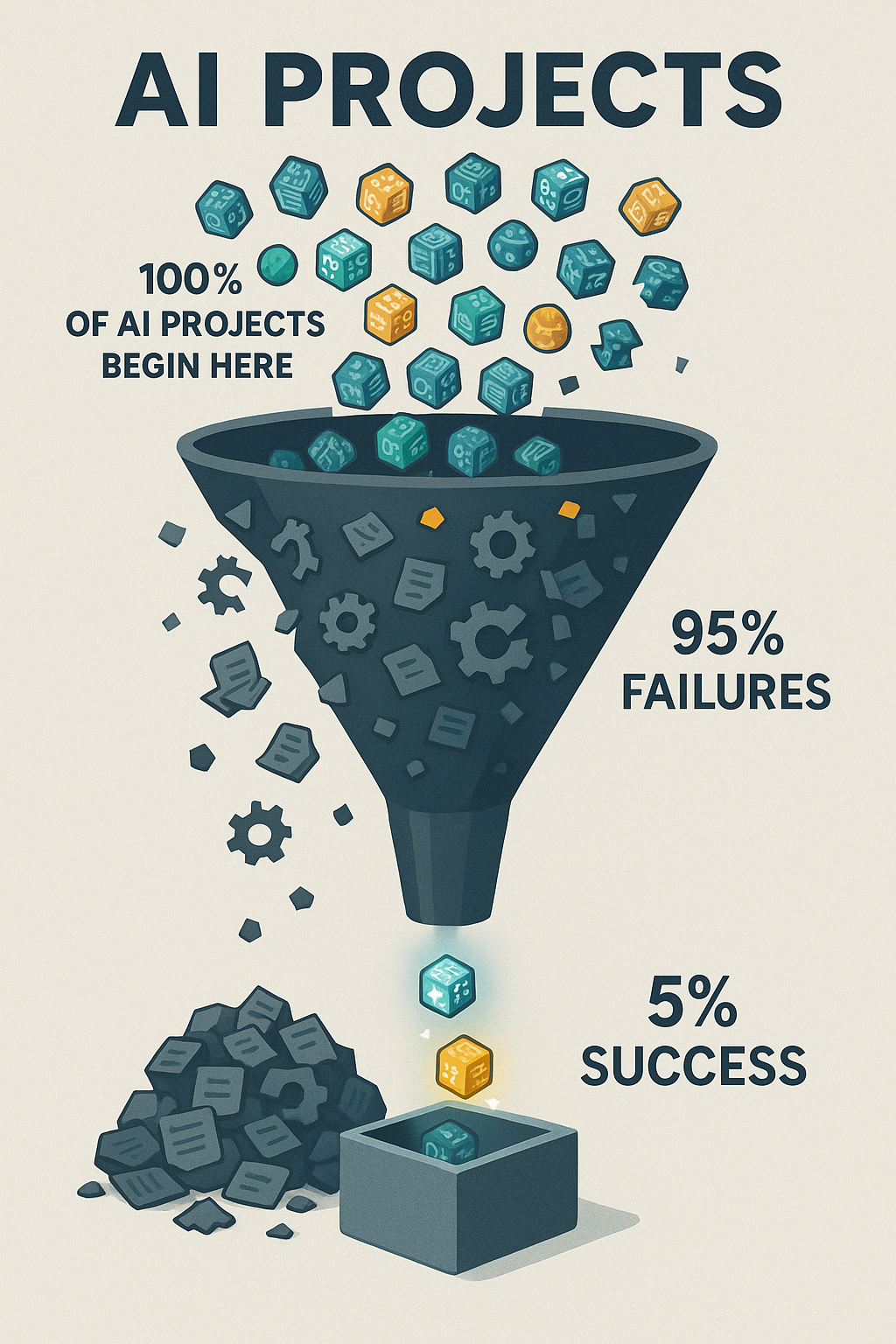
95% of AI Projects Fail. Don’t Let Your Call Center Be One of Them.
By now, you’ve probably heard the stat: 95% of AI projects fail. It’s been splashed across headlines and whispered in boardrooms ever since MIT’s 2024 study on enterprise AI adoption found that the vast majority of pilots fizzle before delivering measurable business value (MIT Sloan, Windows Central, The AI Navigator).
That failure rate isn’t just academic. It’s a warning sign for executives under pressure to “do something with AI.” Boards are demanding results, employees are skeptical, and customers are unforgiving when half-baked solutions make their experience worse. Nowhere is this pressure more acute than in call centers, where AI has been sold as the silver bullet to reduce costs and transform customer experience.
The problem? Most call center AI projects don’t even make it out of the pilot phase. The technology may be powerful, but when the rollout is rushed, misaligned, or poorly integrated, the results are predictable: frustrated employees, wasted budgets, and a public failure that makes the next project even harder to sell.
But here’s the thing—failure isn’t inevitable. A small percentage of organizations are already proving AI can make call centers faster, smarter, and more resilient. The difference isn’t the tools they buy. It’s how they implement them.
Only 5% of AI projects make it to success — a reminder of the challenges and discipline required to deliver real value.
This article will break down why so many call center AI projects fail, and more importantly, what you can do to ensure yours doesn’t.
The Real Reasons Behind the 95% Failure Rate
If we peel back the headlines, the real story behind AI’s 95% failure rate is that most projects collapse under the same set of avoidable mistakes. In call centers, the pressure to “do something with AI” often leads to rushed pilots, unclear success metrics, and cultural resistance long before the technology itself has a chance to prove value. To understand how not to become another cautionary tale, it’s worth starting with the most common—and most fatal—mistake: launching without a clear path to ROI.
1. No Clear ROI
Executives are under pressure to “do something with AI,” so projects often start for the wrong reasons: to appease a board, to follow competitors, or to run with a vendor’s shiny demo. But without a clear business case—shorter handle times, fewer escalations, lower attrition—pilots rarely connect to the P&L.
This is why so many projects stall out after the pilot phase. They look impressive in a slide deck, but when budget reviews come around, leaders ask the one question no one wants to answer: what value did this actually create? If the answer isn’t measurable, the project dies.
2. People and Culture Problems
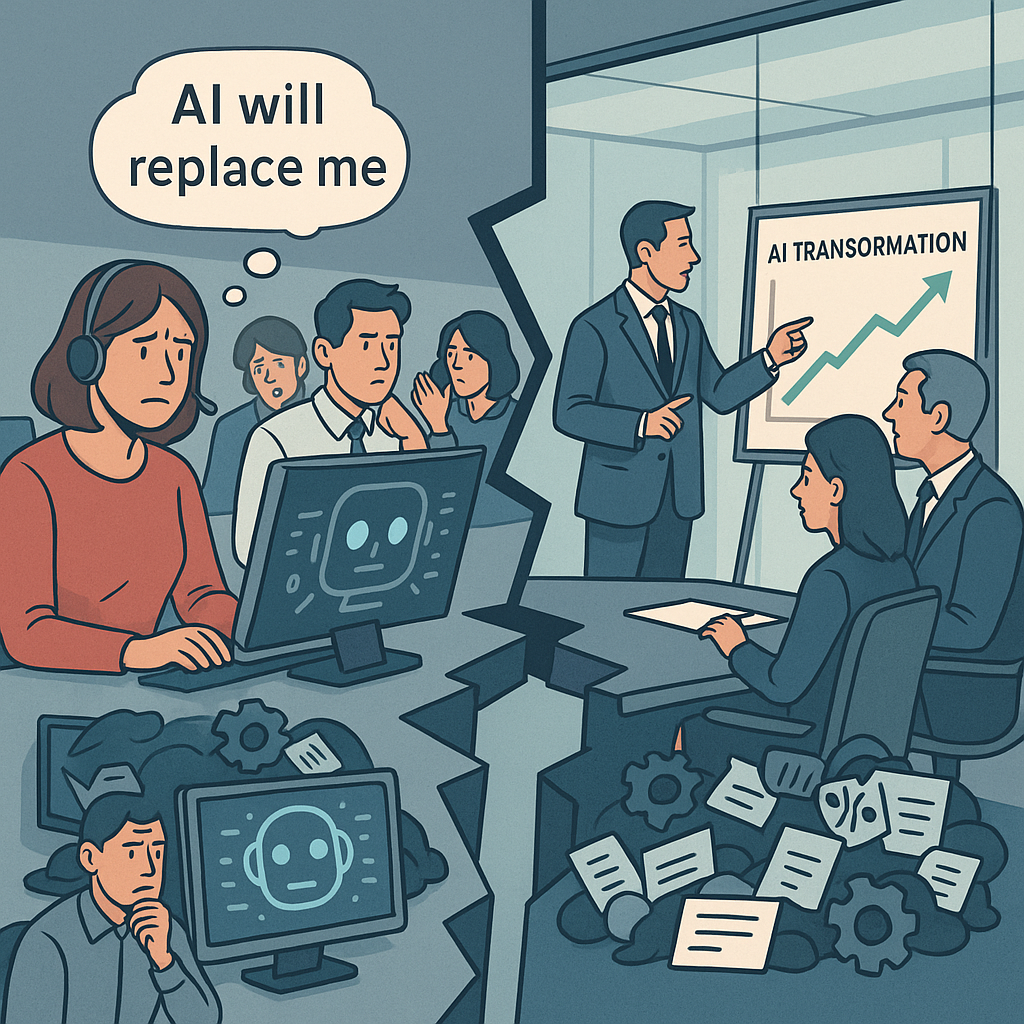
AI adoption isn’t just about technology—it’s about trust. Bridging the gap between leadership’s ambitions and employees’ readiness is the real transformation.
AI transformation doesn’t happen in a vacuum. It happens through people—and too often, people are an afterthought.
Agents see AI as a threat to their jobs. Managers see it as a top-down initiative they weren’t consulted on. And executives underestimate how much training, communication, and cultural readiness is required for adoption. The result? Resistance, slow uptake, and even outright sabotage.
A recent survey by Boston Consulting Group found that less than 20% of frontline employees feel confident using AI in their day-to-day work. If your people don’t understand it, trust it, or see “what’s in it for them,” no amount of investment will make it stick.
3. Broken Plumbing (Integration + Data)
AI isn’t magic—it runs on infrastructure. And in call centers, that infrastructure is notoriously complex. CRMs, telephony systems, workforce management tools, QA software… if the AI solution doesn’t plug into them seamlessly, it creates more friction than it solves.
Then there’s the data problem. Call centers produce mountains of data, but much of it is siloed, messy, or incomplete. “Garbage in, garbage out” isn’t just a cliché—it’s the reality. Poor data hygiene leads to bots giving wrong answers, analytics missing the mark, and employees spending more time cleaning up after AI than doing their actual jobs.
4. Misplaced Bets
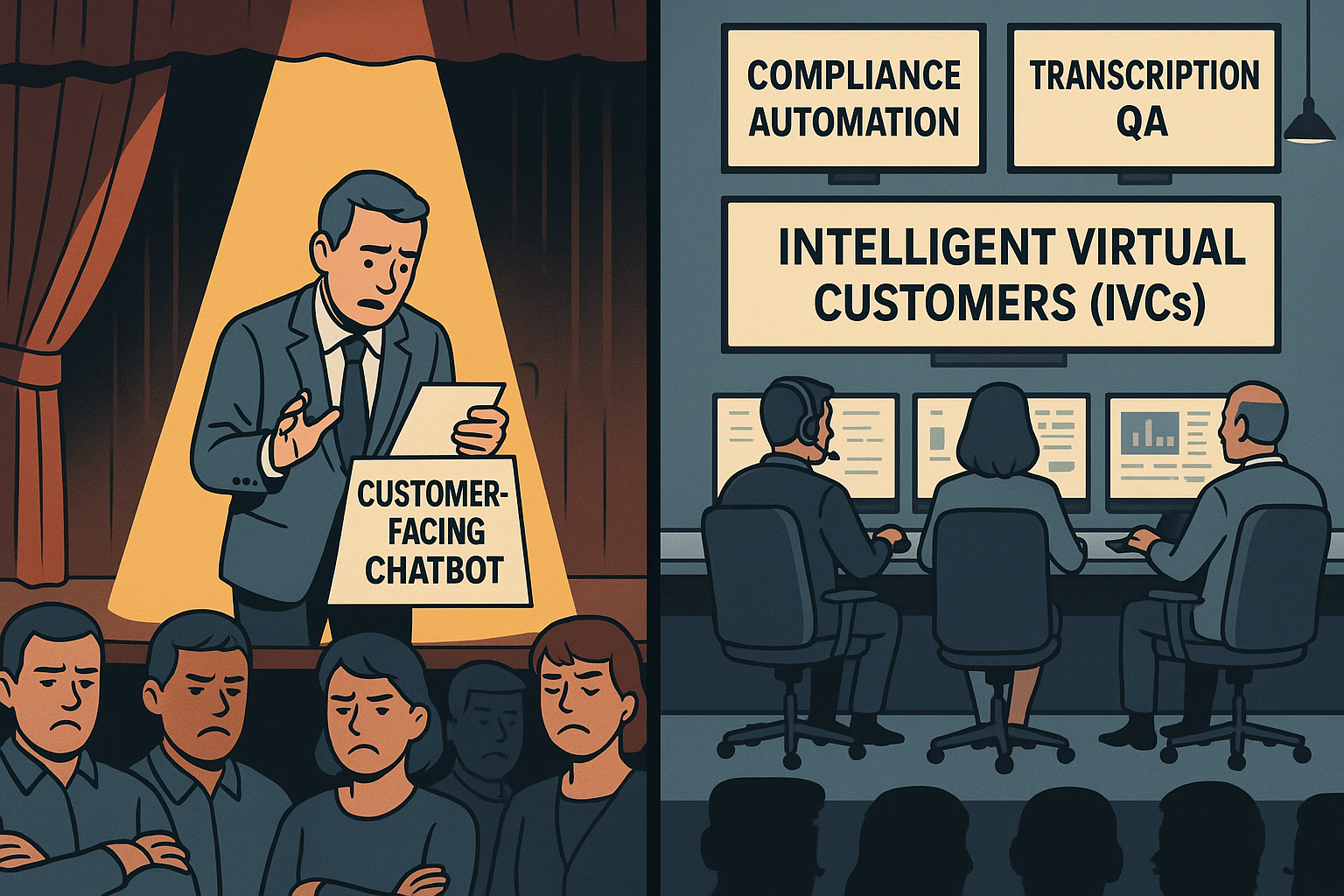
Finally, there’s the temptation to swing for the fences. Leaders want big, customer-facing wins—chatbots that deflect thousands of calls, or voice AI that handles entire conversations. The problem? These are the riskiest bets. Failures are public, employees lose trust, and customers are quick to share horror stories on social media.
Meanwhile, the boring stuff—back-office automation like compliance checks, call routing optimization, or transcript QA—quietly delivers reliable ROI. But because it’s less flashy, it often gets overlooked until budgets are burned and credibility is gone.
The Pattern
Call center AI projects don’t fail because the technology isn’t ready. They fail because organizations underestimate the cultural lift, overcomplicate the rollout, and bet on the wrong projects.
Until those fundamentals are addressed, AI will remain a boardroom talking point instead of a bottom-line driver.
Solutions: How to Avoid Being in the 95%
1. Reduce Variables: Start Small, Not System-Wide
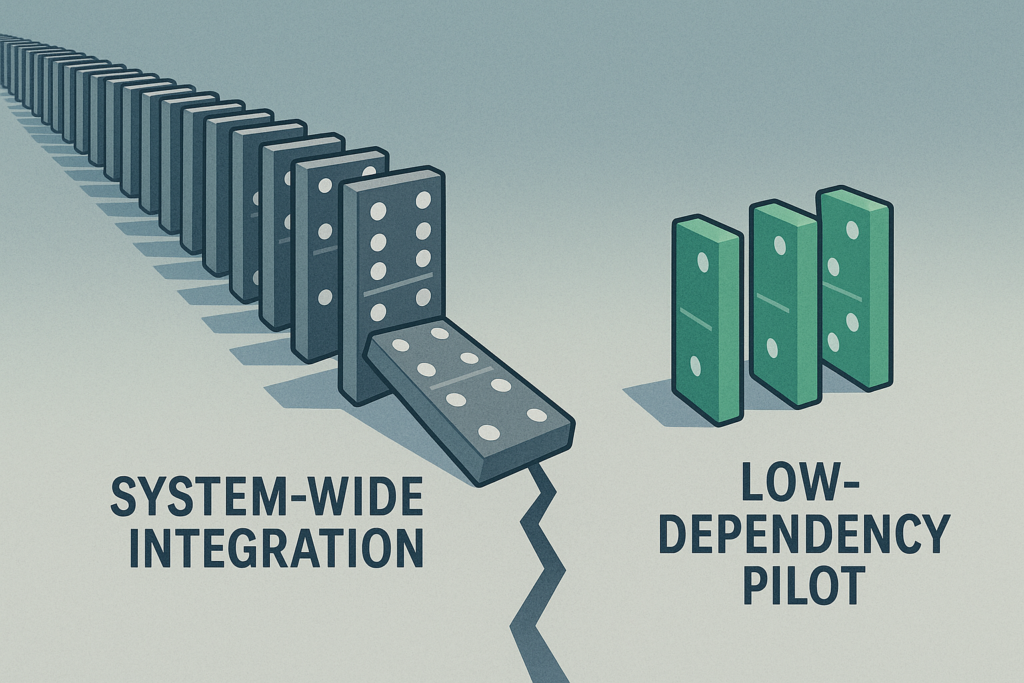
Simplify integration—launch where dependencies are low. The biggest AI failures are not due to the technology; they’re due to how organizations deploy it. Pulling off an enterprise-wide automation without ironing out integration and infrastructure first is a high-risk move guaranteed to detonate mid-flight.
A recent TechRadar Pro analysis labels this the “last-mile problem,” where grand digital transformation plans derail when hitting legacy systems, tangled data governance, and real-world constraints.
Big transformations carry big risks. Start small: a low-dependency pilot offers safety, control, and confidence before scaling.
The lesson: “implementation is strategy”—not just choosing the tech, but ensuring it works in practice.
Similarly, Gartner reports that a whopping 77% of engineering leaders say integrating AI into existing applications remains a major challenge, and advises selecting platforms with cohesive ecosystems rather than patching together disparate tools.
Where to start: low-dependency, high-ROI projects
Call Routing Automation Use AI to intelligently pre-route calls based on simple metadata (region, priority, agent skill set), which often requires minimal CRM integration but delivers clear impact on handling times and customer experience.
Workforce Scheduling Support Implement AI assistants that leverage historical patterns for smarter shift assignments or adherence monitoring—again, typically interacting only with workforce management modules, not full CRM pipelines.
Quality Assurance Automation Instead of automating agent-facing scripts or customer interactions, choose an internal process—like analyzing call transcripts for compliance or sentiment—that runs independently and delivers immediate insight and ROI.
Select initial projects with low system coupling—components that can run nearly standalone or work within well-defined scopes. These “minimum viable integrations” reduce complexity while proving value in real business terms.
2. Build Employee Buy-In Early
From skepticism to empowerment: Make AI feel like a help, not a threat.
Set the Stage with Data
Employee sentiment around AI adoption is fraught with concern. A recent GoTo survey found that 62% of employees believe AI is significantly overhyped, and 86% admit they aren’t using it to its full potential—mainly because they lack confidence in how or where it fits into their day-to-day work.
Meanwhile, a Pew Research Center study shows that only 16% of workers use AI at all, and a staggering 80% do not—highlighting a gap between access and adoption.
These trends reveal a hidden truth: resistance isn’t about stubbornness—it’s about uncertainty.
Focus: Education Before Automation
Instead of positioning AI as a replacement, frame it as a tool that makes agents’ lives easier. Provide contextual training tailored to real workflow scenarios, and walk through how AI can reduce mundane tasks—like auto-sorting inbound calls or flagging compliance breaches—not replace human judgment.
Pilot with Employee Champions
AI adoption spreads best through peer advocacy, not top-down mandates. Identify a group of motivated agents—trusted individuals who are curious and coachable—and involve them early. They act as localized influencers: shaping adoption norms, providing feedback, and demonstrating AI’s value in their own workflows. This grassroots approach builds momentum from the frontline upward.
Build Trust Through Communication
Trust in leadership strongly influences trust in AI. A Harvard Business Review insight underscores that employees are skeptical about AI when they don’t trust the leadership behind it—especially if they feel AI is being used without transparency or benevolent intent.
Open dialogue about AI’s role, limitations, and safety—tracks not just outcomes, but message clarity—makes adoption feel intentional, not imposed.
3. Automate the Back Office First
Minimize risk—let quiet wins build credibility.
While chatbots struggle in the spotlight, behind-the-scenes automation drives efficiency and reliability.
“Automate the back office first” may sound like an overused mantra, but it’s popular for a reason: starting where AI has fewer customer-facing risks gives organizations the breathing room to prove ROI without the PR nightmare of a failed chatbot rollout.
Back-office functions—compliance, transcription QA, performance analytics, and Intelligent Virtual Customers (IVCs)—are ideal launchpads. They’re process-heavy, measurable, and less exposed to the customer’s direct line of sight.
What to Automate First
Compliance Checks: Automate auditing call transcripts to flag regulatory or policy issues.
Transcription QA: Use AI to analyze recordings for accuracy, sentiment, or script adherence.
Performance Analytics: Spot patterns in agent productivity, escalation trends, or customer sentiment shifts.
Intelligent Virtual Customers (IVCs): Synthetic customers designed to simulate real conversations. Instead of risking failure with live customers, IVCs let you test, train, and refine AI models against realistic scenarios—quietly, safely, and cost-effectively.
Case in Point: Commonwealth Bank’s Cautionary Tale
When Australia’s Commonwealth Bank (CBA) pushed AI voice bots directly into customer service, the outcome was public and painful. Bots failed to resolve issues, call volumes rose, and 45 jobs were cut prematurely before the bank had to backpedal amid backlash.
It’s a textbook example of chasing a headline instead of proving AI’s value in safer, internal domains first.
Why It Works
Low visibility = low risk: Errors happen behind the scenes, not in front of customers.
Proof of value: Automating “boring but critical” processes shows real, measurable ROI.
Foundation for scale: Early wins build executive and employee confidence for more ambitious rollouts.
4. Vendor Strategy: Safe Bet vs. Fast Bet
Choosing the right partner can make or break your AI project.
Option 1: Incumbent Vendors — The Safe Bet
Large, established vendors (think your existing CRM, workforce management, or cloud providers) come with undeniable advantages: scale, security, and the credibility that reassures your board. They’ve delivered before, and they’ll integrate into your existing tech stack with less friction.
The trade-off? Speed. Big vendors often move slowly, layering AI into their products incrementally. You’ll sacrifice agility for stability—but for some executives, especially those under scrutiny from boards or regulators, that’s the right call.
Option 2: Startups — The Fast Bet
Smaller, specialized vendors often innovate faster. They can spin up pilots in weeks, customize deeply for niche workflows, and push the boundaries of what’s possible with AI.
But there are risks: limited resources, unproven scalability, and the potential for hiccups that frustrate employees or erode credibility with customers. A failed startup partnership can set your AI agenda back years—not because the tech was bad, but because your organization loses confidence.
Vendor Strategy: Safe Bet vs. Fast Bet
Factor
Incumbent Vendor (Safe Bet)
Startup Vendor (Fast Bet)
Speed to Deploy
Slower, incremental rollout
Fast, agile pilots
Integration
Strong alignment with existing stack
Flexible, but may require workarounds
Credibility with Board
High — proven track record
Mixed — depends on reputation
Risk of Failure
Low technical risk, slower ROI
Higher risk of hiccups, potential setbacks
Innovation
Steady, but rarely disruptive
Cutting-edge, niche solutions
Scalability
Enterprise-grade, reliable
May struggle at large volumes
Best Fit When…
Board/regulators demand stability; credibility matters most
Speed and differentiation are critical; appetite for risk is higher
Hybrid Strategy
Use for customer-facing or mission-critical AI
Use for back-office pilots and innovation sprints
The Executive Framework: Choosing Your Path
When deciding between safe and fast, align the choice to your risk appetite and board expectations:
If credibility matters most: Stick with incumbents. They provide a defensible, low-risk path to AI adoption.
If speed and differentiation are critical: Partner with startups. Be ready to embrace hiccups as the price of innovation.
If you want both: Consider a hybrid strategy—pilot with a startup in the back office (low risk, high learning), while aligning your customer-facing roadmap with a trusted incumbent.
Bottom line: There’s no “right” choice, only the choice that fits your strategic posture. The wrong vendor isn’t just a missed opportunity—it can turn your call center into another 95% statistic.
Executive Playbook: Making Call Center AI Work
AI success in call centers isn’t about chasing the flashiest tools. It’s about discipline, focus, and choosing battles you can win. Here’s the checklist every executive should keep in mind before greenlighting the next AI project:
✅ Tie Every Pilot to Measurable ROI
If you can’t connect the project to the P&L, don’t start it. Define success upfront in hard metrics: reduced handle time, lower attrition, higher CSAT, or compliance cost savings. Every pilot should answer the board’s question: “What business value did this create?”
✅ Pick “Low Surface Area” Projects First
Start where integration is simplest and dependencies are minimal. Call routing, workforce scheduling, and QA automation deliver quick wins without touching every system in the stack. Prove value before attempting system-wide transformations.
✅ Train Employees and Align Incentives
AI doesn’t work if people won’t use it. Invest in education that shows employees how AI helps their workflows, not replaces them. Reward early adopters, celebrate quick wins, and use employee champions to spread momentum.
✅ Prioritize Back-Office Before Customer-Facing
Public-facing AI failures destroy credibility fast. Back-office automation—compliance checks, transcription QA, performance analytics, Intelligent Virtual Customers (IVCs)—delivers ROI quietly while giving you space to refine the technology.
✅ Match Vendor Choice to Risk Appetite
Don’t let vendor selection be an afterthought. If stability and credibility matter most, lean on incumbents. If speed and differentiation are critical, partner with startups. Better yet, build a hybrid strategy: use startups for low-risk pilots, then scale with trusted incumbents.
The Bottom Line
AI projects succeed when leaders treat them as business initiatives, not tech experiments. Anchor every step in ROI, simplify your first moves, bring employees along for the ride, and choose vendors with your strategic posture in mind. Do this, and your call center won’t just avoid being part of the 95%—it will help define the playbook for the 5%.
TLDR; The 5% Opportunity
The numbers may be grim—95% of AI projects fail—but they’re not destiny. For call centers, success isn’t about betting on the flashiest AI or rushing to impress the board with a chatbot demo. It’s about focus, realism, and cultural readiness.
The difference between the 95% that fail and the 5% that succeed isn’t the technology. It’s leadership. Leaders who demand measurable ROI, start small, bring employees along, and place smart vendor bets are already proving AI can make call centers more efficient, resilient, and customer-centric.
As an executive, you don’t have the luxury of treating AI as an experiment. Your job, your team, and your customer experience depend on getting it right. The good news: you can get it right—if you build deliberately, not reactively.
So here’s the call to action: Don’t chase the hype. Build the foundation that makes your call center part of the 5%.