Tag: coaching

  • How to Stop the Self-Fulfilling Prophecy of Contact Center Agent Churn

    How to Stop the Self-Fulfilling Prophecy of Contact Center Agent Churn

    It’s Vivian’s first live shift at her contact center job. Her company’s IVR and AI tools have already absorbed the easy calls, leaving her with escalations, edge cases, and emotionally charged situations. 

    Frustrated customer after frustrated customer calls in: one customer had their power shut off; one had a billing dispute that already failed twice; and another has already had to repeat their story three times before reaching a human. 

    Vivian isn’t expected to perform well on her first day. And she isn’t set up to do so, either. The unspoken message is clear: let’s see if she makes it. 

    We call this “ramp,” but it’s more like throwing someone in the deep end and seeing if they sink or swim. 

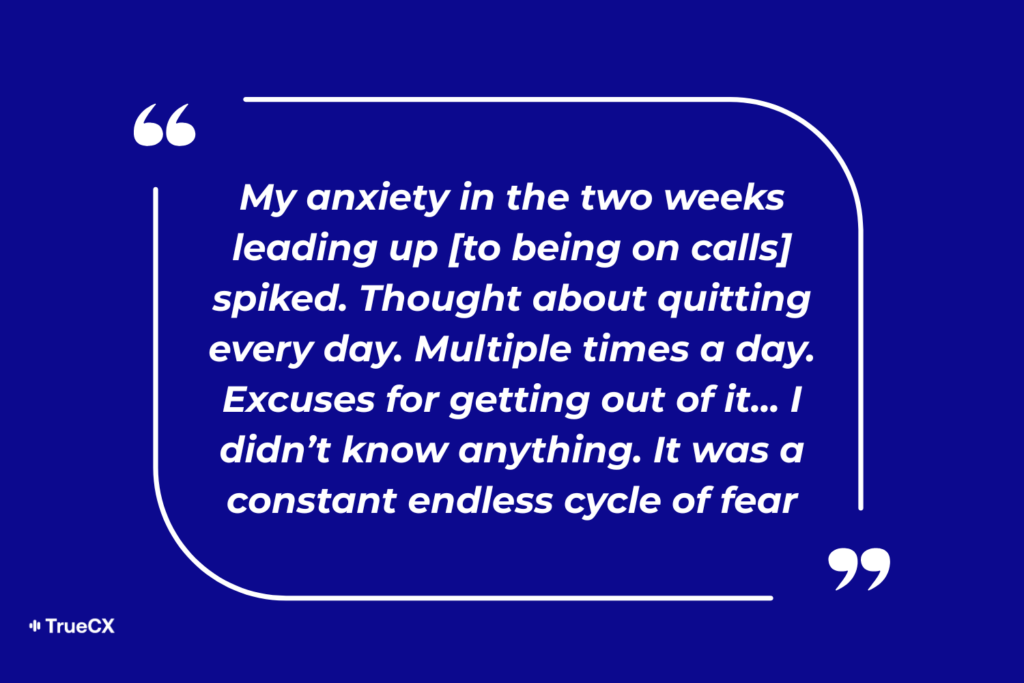
    “On the first day of my first call, I had everything ready 30 minutes beforehand: connection, cubicle, headset, paper for notes… but I was so nervous about not knowing what would happen that just five minutes after logging in, I threw up all over the place.”

    — r/CallCenterWorkers on Reddit

    When we design the first 90 days on the job as a probation period instead of a support and incubation period, churn risks becoming a self-fulfilling prophecy. 

    The Signal We Send Agents on Day One

    At most contact centers, new agents have lower performance expectations, and aren’t eligible for bonuses during their first 90 days. 

    With no incentive to succeed, a powerful narrative is created: you’re not part of the team yet. We expect you to fail. 

    When bonus incentives are delayed, one of your most powerful incentives is removed during the most high-efforts and stressful periods of the job. 

    Why should Vivian go above and beyond if she’s not going to be rewarded? Why shouldn’t she just quit, if her company doesn’t believe in her anyway? 

    How the Prophecy Becomes Reality

    Here’s how Vivian’s first 90 days goes:

    • She struggles on some of her harder calls
    • Her mistakes are public and impact the company’s bottom line
    • Her confidence is eroded and her stress level is higher
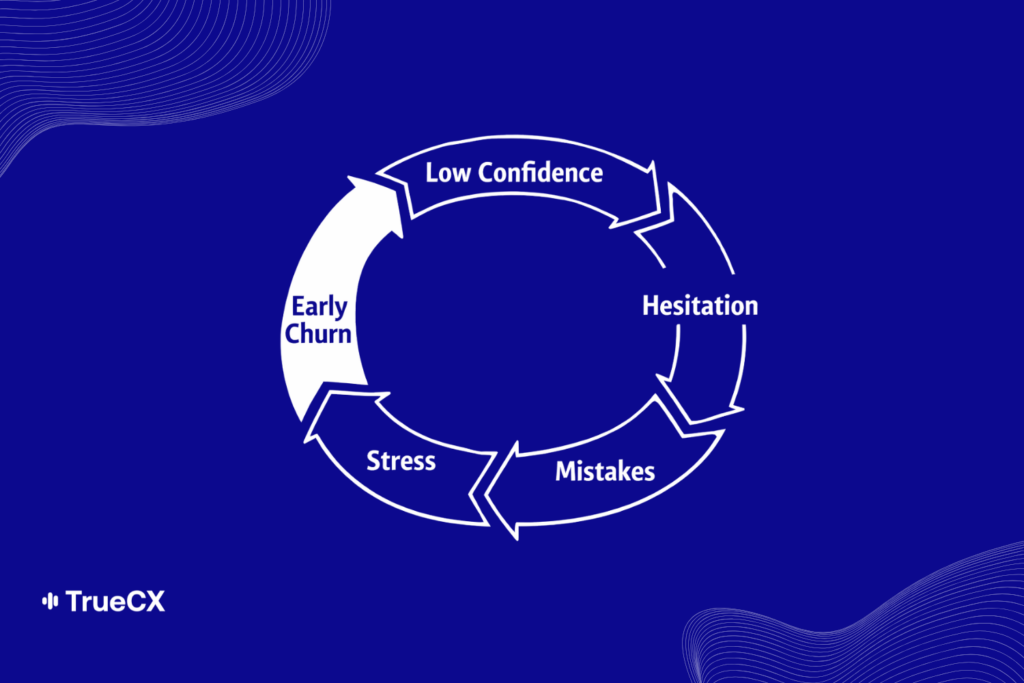
    • This leads to more mistakes, more scrutiny, and more emotional fatigue
    • She doesn’t feel like her company cares about her development, performance, or whether she stays or goes
    • So she quits before the 90 day mark

    The first 90 days on the floor are when habits form; they determine whether an agent sees their job as a career path or a temporary stopover. 

    And once churn becomes normalized during an agent’s first 90 days, it reshapes a contact center’s entire culture. Supervisors expect attrition; operations teams bake it into their forecasts; and hiring plans are built up to account for it. Performance ceilings lower, and failure becomes the norm. 

    “I remember that I started half an hour earlier than the rest of my team and my manager didn’t get in until 1 1/2 hours into my shift. We had a support line but they too weren’t open right away. It was frustrating, being new on the phone and not having any support. I ended up absorbing info on the job like crazy because otherwise I wouldn’t get any help.”

    — r/CallCenterWorkers on Reddit

    Given the outsized cost of churn, contact centers need to question those norms more critically. Consider:

    • Recruiting and training costs
    • Lost productivity during ramp
    • Supervisor time spent on coaching and training
    • Forecast instability during high-volume periods

    Ramp time and churn are not just HR metrics – they’re operational efficiency metrics. 

    Calculate The Cost of Treating Ramp Like a Trial Period

    Use this simple calculator to estimate the financial impact of early churn during an agent’s ramp period:

    Ramp Cost Calculator

    Estimate the annual cost of treating ramp like a trial period.

    This calculator provides directional estimates only. It does not include secondary costs like QA volatility, supervisor bandwidth, lower CSAT, or scheduling disruption.

    How to Stop the Cycle

    Breaking the self-fulfilling prophecy of contact center churn doesn’t require a complete overhaul. Consider these four steps:

    1. Align Incentives from Day One

    Think about extending bonus eligibility to new agents during ramp. This signals belief and trust, and early financial wins in this regard can reinforce effort and resilience. 

    2. Redesign Call Exposure

    A new agent shouldn’t experience their first difficult call or escalation live and unprepared. Structured simulations like Intelligent Virtual Customers (IVCs) allow agents to practice calls in true-to-life environments without the pressure of real metrics and customers. 

    3. Measure Readiness, Not Just Completion

    Typical contact center metrics like AHT, FCR, and QA scores are lagging indicators. You need a way to make sure an agent is ready to hit the phones proactively, not reactively. 

    Some leading indicators to consider measuring include:

    • Objection-handling confidence
    • Comfort with policy and tool navigation
    • Success rate when a call simulation goes off-script
    • Rate of improvement over time, especially on complex calls 

    4. Redefine Ramp

    Shift from viewing an agent’s first 90 days as a trial period into viewing them as an incubation period. Instead of “let’s see if they make it,” let’s switch to “how do I make sure they succeed?” 

    Agents feel the difference when they are believed in and supported, and they will be more likely to achieve early wins and stay resilient through early losses. 

    The First 90 Days Predict The Next 900

    Contact centers don’t inherently have a churn problem. They have a ramp design problem. 

    When we expect churn, and design policies and cultures that reinforce it, we are creating a self-fulfilling prophecy that leads to heavy operational costs. 

    But when we design for support, readiness, and proficiency, we can achieve the opposite: stability, confidence, and real performance improvement. 

  • What Unprepared Agents Really Cost You

    What Unprepared Agents Really Cost You

    The true cost of “on-the-job” learning

    AI is quietly reshaping many contact centers. With IVR handling balance checks, bots resetting passwords, and voice agents resolving simple billing questions, what’s left for your agents?  

    The answer: the most complex, emotionally charged edge cases that automation and AI simply can’t handle. 

    And while the call mix has changed, agent training hasn’t – or hasn’t changed enough. 

    Your agents know your policies, they’ve completed your onboarding modules, and they’ve shadowed a few calls. But they haven’t practiced in realistic, high-pressure environments. 

    The result is not just a slower learning curve or more escalations – its true operational losses. 

    Let’s break down where that cost shows up. 

    Cost Per Lead

    In many industries like utilities, home services, and insurance, calls are revenue opportunities. Marketing and sales teams have spent real time and resources to generate inbound and outbound leads. 

    Here’s what could happen if a new agent mishandles these calls: 

    • The potential customer hangs up
    • The potential customer doesn’t call back
    • The potential customer delays a purchase by several more touches
    • The potential customer chooses one of your competitors

    The lost revenue opportunity and increase in cost per lead digs away at your bottom line; each additional minute on the phone or additional touchpoint to re-activate a potential customer adds up fast. 

    Customer Satisfaction Score (CSAT) and Loyalty

    Consider a customer calling into your contact center with a highly emotional issue. Maybe their power was shut off, or their insurance claim was rejected, or they are stranded after a flight cancellation. 

    When a new agent hesitates, provides unclear information, puts that customer on hold for too long, or transfers them multiple times, the customer experience degrades fast, and their sentiment dips from bad to worse. 

    This affects more than just customer satisfaction and CSAT surveys. It affects renewal, churn, revenue, and trust. A single bad interaction during a critical moment can undo years of positive service and brand loyalty. 

    Average Handle Time (AHT)

    Without proper preparation in true-to-life circumstances, new agents will simply take longer to do their jobs. They’ll put customers on hold more frequently and for longer periods of time, re-read scripts before speaking, search for answers across multiple systems, and escalate when they’re not 100% sure of a solution. 

    Even a one-minute increase in AHT per call compounds quickly. Multiply this by your calls per month and see the costs start to add up in:

    • Longer queues
    • Higher call abandonment
    • Higher staffing requirements
    • Overtime

    Each extra minute of AHT chips away at your bottom line metrics and overall efficiency. But there is a cascade effect, too:

    • More compliance risk, as agents rush to recover time later on other calls
    • More fatigue for agents, as longer calls signal complexity and strain
    • Less time for coaching, because supervisors are covering escalations 
    • Lower customer satisfaction, as customers spend longer on the phone for issues that should have been resolved quickly

    Operational Dispatches

    In companies with an element of field work, like property management, home services, and utilities, agents may default to dispatching a team member on-site as a safe way to de-escalate and end a conversation. 

    But if an issue could have been resolved remotely, this creates a serious operational burden. Consider the hours a member of your team spends traveling, the money spent on gas, and the potential, worthy on-site visits they could have been doing in the meantime. 

    And if the onsite visit wasn’t necessary to begin with? You risk eroding customer trust, too. 

    Now multiply that by tens or hundreds of avoidable dispatches per month. 

    Escalations

    When new agents struggle, the issues don’t stay with them. Experienced agents or supervisors step in to provide additional training, QA, coaching, and escalation support. This all adds up to minutes or hours where your MVPs are off the phones. 

    Your best performers should be on the front lines, not cleaning up training gaps or doing reactive firefighting. 

    Ask yourself:

    • For top agents: Who is now taking calls instead of your top performers? If your highest-converting, highest-performing agents are pulled into support or escalations, your calls will shift to mid-tier or new agents. This redistribution quietly lowers conversion and CSAT and raises AHT and risk. 
    • For supervisors: Where could that leadership capacity be going instead of doing reactive coaching? What broader improvement initiatives are being put on the backburner? Every minute spent resolving preventable issues is time not spent analyzing trends, reigning workflows, improving systems, or coaching. Over time, this resource scarcity puts your supervisors in reactive mode instead of proactive mode. 

    Attrition

    It’s no secret that early performance is directly correlated to churn in an agent’s first 90 days. In a COPC study, only 71% of agents felt that their onboarding adequately prepared them for success, down 3% from previous years. 

    When agents are thrown into emotionally intense situations without realistic practice, confidence plummets fast. And low confidence leads to stress, burnout, and voluntary exits.

    Imagine that a new agent logs in for their first live shift on day one. The low-hanging fruit of password resets and balance checks are automated, and the first call routed to them is a customer whose power has been shut off and is worried about losing refrigeration for their grandmother’s medication. 

    The agent knows your policies in theory – they covered them in training – but now the customer is audibly upset. There are compliance implications to consider, system notes to catch up on, and customer satisfaction to consider all at the same time. 

    So the agent hesitates. They put the customer on hold. They escalate. This happens over and over again, and by the end of their first week, the agent is dreading each and every call. By the end of their first month, they’re questioning whether this is the right job for them. 

    Replacing that agent, who could have been a top performer if properly set up for success, costs thousands in recruiting, training, and lost productivity. 

    And if the reasons behind churn haven’t changed, this becomes a self-fulfilling prophecy.

    A cultural expectation that new agents won’t be here long leads to lower overall expectations, failure as a status quo, and the perception of your contact center as a cost center – also a self-fulfilling prophecy. 

    But there are real ways to stop the cycle. 

    Don’t Turn Your Customers Into Coaches

    In many contact centers, live calls still function as one of the primary classrooms for new agents. But your customers are the most expensive coaches imaginable. 

    The alternative? Improved training and coaching that leads to real agent readiness

    Tools like Intelligent Virtual Customers (IVCs) allow your agents to build confidence and readiness with realistic AI customers who talk, respond, and react like your actual customers. 

    Compare the cost of improving your training to the math of what unprepared agents really cost you, and ending the cycle of churn and burn becomes a no-brainer. 

  • Metrics to Track Before Agents Take Their First Call

    Metrics to Track Before Agents Take Their First Call

    Most contact centers wait until agents are live on the phones in order to measure performance, but by that point, the stakes are already sky-high. Mistakes affect real customers, escalations pile up, supervisors are pulled in, and new agents feel under immense pressure to perform immediately. 

    When performance issues show up after an agent hits the floor, training teams are forced to be reactive instead of proactive. Tracking the right metrics allows for intervention at the contact center agent training stage, shortening ramp time and protecting both agents and customers when it matters.

    This guide covers the metrics to track during agent onboarding and training so you can prevent problems and set agents up for success before they take a real call. 

    Here are the key metrics to track before an agent takes their first call: 

    Readiness and Confidence Metrics

    If an agent doesn’t feel prepared to take live calls, they are far more likely to struggle the moment a conversation goes off-plan. In this way, readiness and confidence metrics are early predictors of churn. 

    Low confidence leads to hesitation, hesitation leads to mistakes, and mistakes create stress and early exits. 

    By tracking readiness and confidence alongside call center agent training completion, L&D teams can keep their finger on the pulse of which agents are ready, which need a little more practice, and which need targeted support. 

    Readiness and confidence metrics include:

    • Success Rate
    • Number of “Reps” to Reach Competence
    • Improvement Over Time
    • Self-Reported Confidence

    Call Handling Quality Metrics

    Keeping an eye on call handling quality metrics during training helps avoid QA issues down the line. But with traditional contact center agent training, it’s hard to simulate the real-world scenarios that could lead to sup-bar QA scores in the real world. 

    With Intelligent Virtual Customers (IVCs), agents can have true-to-life conversations with AI customers who sound, respond, and react like real customers. IVCs make call handling quality metrics trackable on day zero, far before real customers are on the line. 

    Call handling quality metrics include: 

    • Script Adherence
    • Information Accuracy
    • Objection Handling
    • Compliance Adherence

    Escalation and Recovery Metrics

    Agents who escalate frequency or struggle to recover from escalations will experience higher stress and burnout once they’re live on calls. Frequent escalations also put an additional burden on supervisors and top agents who will likely be called in for support. 

    Source

    When agents aren’t exposed to realistic, challenging scenarios in their training, those first few difficult calls can feel entirely overwhelming. Evaluating escalation and recovery skills before agents go live, and training them with IVCs, makes it possible to improve agent performance without risking the real customer experience. 

    Example metrics include:

    • Escalation Frequency
    • Time to De-escalation
    • Successful De-escalation Rate

    Why Contact Center Agent Onboarding & Training Metrics Matter

    Tracking these key metrics before agents ever talk to a real customer means your training organization can move from reactive correction to proactive readiness, putting in place best practices before bad habits have the opportunity to take hold. 

    These early indicators help teams:

    • Reduce churn
    • Improve QA scores
    • Strengthen compliance scores
    • Lower escalation rate
    • Reduce average handle time
    • Protect CSAT and NPS

    Taken together, these metrics lead to a more consistent customer experience, higher-achieving agents, and a stronger bottom line. 

    But measuring these core metrics requires realistic practice, and classroom training and traditional roleplay cannot replicate the actual experience of being on a call with a customer. By creating lifelike practice environments for your agents, IVCs can help you measure readiness metrics and ensure your agents hit the floor running on day one. 

    Turn Early Signals Into Better Results

    Doing fundamental training when agents are already on calls is a quick way to negatively impact your contact center’s bottom line. The risk to customers and agents alike is too high to ignore; the earlier your learning and development team can measure, monitor, and train these foundational metrics, the better. 

    Readiness, quality, and escalation issues appear during onboarding, and they can be stopped during onboarding, too. When these signals are tracked in advance, trainers can intervene sooner and reduce the downstream operational impact that shows up once live customers are in the mix 

    For operations leaders, this means fewer surprises and more predictable performance. For learning and development leaders, it means clearer proof that call center agent training directly influences business outcomes.

    Get in touch if you want to learn more about TrueCX and how Intelligent Virtual Customers (IVCs) can help you measure business-critical metrics as early as their first day of onboarding. 

    Want more insights like this?

    Subscribe to WizeCamel’s newsletter—the #1 resource for contact center trainers—for the latest in AI-powered training, team performance strategies, and real-world tips for building a stronger, smarter contact center, starting with contact center coaching.

  • The LED Coaching Light: A Contact Center Coaching Tool that Actually Works

    The LED Coaching Light: A Contact Center Coaching Tool that Actually Works

    The LED Coaching Light: A Contact Center Coaching Tool that Actually Works

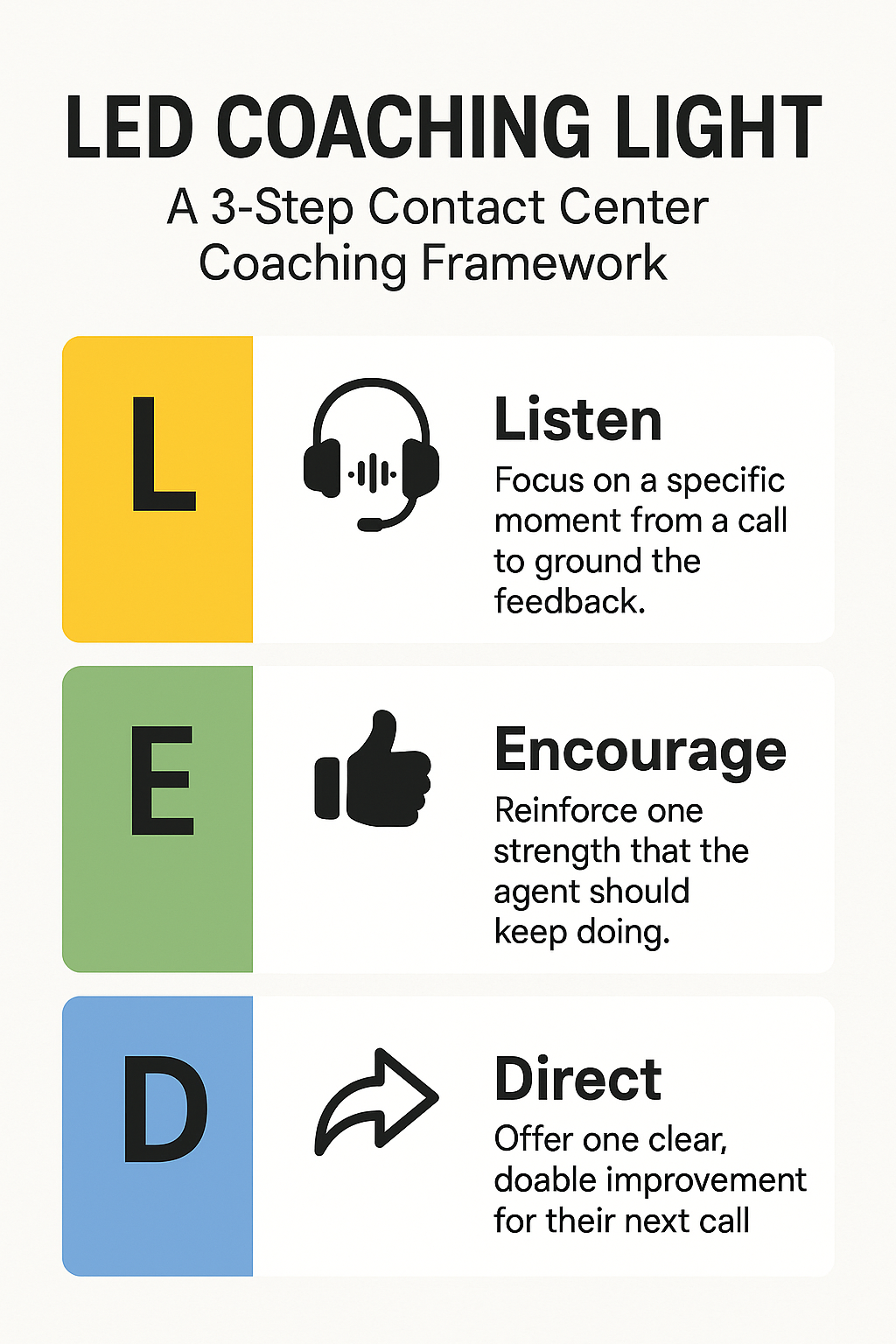
    A vertical infographic titled “LED Coaching Light: A 3-Step Contact Center Coaching Framework.” It shows three color-coded panels: yellow for “L – Listen” with a headset icon, green for “E – Encourage” with a thumbs-up icon, and blue for “D – Direct” with a forward arrow icon. Each panel has a short caption describing the step.
    A simple, professional 3-step framework (Listen, Encourage, Direct) for effective contact center coaching.

    Imagine Laura, a busy frontline supervisor in a bustling contact center—managing 15 agents, back-to-back calls, rising KPIs, and a literal queue of managers requesting her time. She wants her team to improve—but she’s swamped. Every coach call is either rushed or skipped. She hears her agents respond with glazed-over faces. “What could you have done differently?” The question lands flat.

    But Laura tries something new. For the next week, between calls, she uses a “LED moment” with each agent—just 60 seconds. She listens to a quick snippet, praises real strengths, and gives a single, practical tip. By week’s end, agents report feeling supported; QA scores tick upward. It wasn’t magic, but it was intentional.


    Why Contact Center Coaching Matters

    In contact centers, feedback feels like a compliance checkbox—but it doesn’t have to be. Studies show that:

    • 75% of agents receive coaching at least monthly and 72% say these sessions are useful (Calabrio, Why Agent Coaching Matters)
    • Consistent coaching like this boosts first-call resolution, which correlates 1:1 with customer satisfaction—every 1% FCR uptick improves satisfaction by 1% and NPS by 1.4 points. (Wikipedia, FCR)
    • Coaching not only improves performance—it reduces turnover. Centers with high-manager floor time have double the staff retention compared to those without. (McKinsey, Smarter Call Coaching)

    Attracting the right people is half the battle—keeping them is the other. A strong coaching culture empowers agents while strengthening loyalty and reducing costly churn.


    Why the LED Coaching Light?

    Research shows that traditional coaching often fails due to:

    • Managers bogged down in prep and admin
    • Agents needing multiple reminders before adopting new skills
    • Too many formal reviews and not enough in-the-moment guidance

    LED Coaching Light solves this. It’s:

    • Fast: Under 5 minutes
    • Focused: One strength, one micro-improvement
    • Human: Built on real call snippets, delivered casually

    Laura’s story isn’t rare—it’s replicable. If you want coaching that works in the real world of contact center stress and urgency, LED delivers. And makes contact center coaching feel like something managers want to do.


    What is the LED Coaching Light?

    L – Listen
    Start with a small, specific snippet of a call. Either play back a short segment or summarize it clearly. No need to rehash the entire call—just anchor the feedback in a concrete moment.

    E – Encourage
    Find something to reinforce. This isn’t about fluffy praise—this is about pointing out what worked so the agent knows to keep doing it.

    D – Direct
    Offer one improvement. Just one. It should be clear, doable, and worth implementing on the very next call.


    LED in Real-World Coaching Scenarios

    Scenario 1: Soft Skills on a Tough Call

    Jenna took a call from an upset patient waiting on a prescription. She stayed factual but sounded clipped.

    Listen: “Let’s review the section around minute 3 when the patient asked for a faster resolution.”
    Encourage: “You stayed calm and didn’t interrupt. That’s a win—staying composed when someone’s venting isn’t easy.”
    Direct: “Next time, try: ‘I hear how frustrating this is. Let’s go over your options together.’”

    ScenarioOriginal PhraseLED TipImproved Phrase
    Jenna’s call“There’s nothing we can do”Add empathy“I hear your frustration—let’s go over options”

    Scenario 2: High Performer, Small Miss

    Luis skipped the greeting and dove right into solving the issue.

    Listen: “Here’s where the call starts—no greeting.”
    Encourage: “Your problem-solving speed is top-notch.”
    Direct: “Let’s still open with ‘Thanks for calling—Luis here.’ That sets a consistent tone.”

    ScenarioOriginal PhraseLED Tip (Direct)Improved Phrase
    Luis starts the call without a greeting and jumps straight to problem-solving“Okay, let me pull up your account…”Add a warm, consistent greeting to set the tone“Thanks for calling—this is Luis. Let me pull up your account…”

    Scenario 3: New Agent, Confidence Check

    Ashley hesitated explaining a denied claim policy.

    Listen: “This part where you explained the denial stood out.”
    Encourage: “You didn’t over-apologize, and you stayed respectful.”
    Direct: “Add: ‘Here’s what you can do next.’ It shifts focus from denial to action.”

    ScenarioOriginal PhraseLED Tip (Direct)Improved Phrase
    Ashley hesitates when explaining a denied claim and ends the call abruptly“Unfortunately, the claim was denied… that’s all I can say.”Shift focus from denial to next steps to build confidence and clarity“The claim was denied—but here’s what you can do next…”

    Using LED Without Making It Weird

    • Keep it casual: Use LED on the fly—after a call, in a chat, or during side-by-sides.
    • Make it consistent: A quick LED moment each week per rep builds momentum.
    • Don’t overdo it: If there’s no obvious correction, stick to encouragement.

    TL;DR: LED Coaching Light

    L – Listen to a moment in the call
    E – Encourage one strength
    D – Direct one simple improvement

    Quick. Specific. Actually useful contact center coaching.


    FAQs About Contact Center Coaching with LED

    What makes LED different from traditional contact center coaching?

    It’s fast, low-pressure, and focused on real-time feedback—designed for the real world, not HR checklists.

    Can LED be used in non-voice channels?

    Yes. Just replace “Listen” with “Review”—the same flow works for chat, email, and SMS transcripts.

    Do I have to find something to fix on every call?

    Not at all. Some LED moments are just about celebrating progress.

    How do I track LED coaching?

    Keep it lightweight: use a shared spreadsheet or embed a form in your QA system with “L-E-D” fields.

    How do I get buy-in from my supervisors?

    Start small. Try LED in a team huddle or pilot it with one team. Managers will feel the difference—and so will agents.

    Want more insights like this?

    Subscribe to TrueCX’s newsletter—the #1 resource for contact center trainers—for the latest in AI-powered training, team performance strategies, and real-world tips for building a stronger, smarter contact center, starting with contact center coaching.