Most contact centers believe their training is effective, but how many actually measure it?
We might evaluate completion—agents complete onboarding, pass quizzes, get certified—but are we measuring true readiness? Once agents hit the floor, are they confident and ready to take difficult calls?
This gap isn’t solved by more training, but rather with an understanding of what kind of training (and what kind of measurement) actually translates into real performance improvement and readiness.
When used intelligently, that’s what the Kirkpatrick Model is designed to do.
What Is the Kirkpatrick Model?
The Kirkpatrick Model has been around since the 1950s and is one of the most widely-used frameworks for evaluating the effectiveness of training programs.
It breaks down learning into four levels:
Reaction: Did agents enjoy the training?
Learning: Did they understand the material?
Behavior: Did they apply the training on the job?
Results: Did the training drive business outcomes?
It’s a simple and intuitive model, but easy to misapply, especially in fast-paced environments like contact centers.
How the Kirkpatrick Model is Applied in Contact Centers
Level 1: Reaction
In a contact center, Level 1 of the Kirkpatrick Model is usually evaluated through post-training surveys that ask agents to report their experience of a given training program. Questions like “Was this helpful?” or “Do you feel confident with your knowledge of this subject?” help evaluate whether or not agents were engaged during training.
But positive feedback doesn’t always predict performance. An agent can enjoy and actively participate during training and still struggle tremendously on live calls.
Level 2: Learning
Level 2 evaluates whether or not agents understand the material provided during a training session. Most contact centers evaluate Level 2 through knowledge checks, certifications, exams, and role plays.
At this stage, most agents can repeat and regurgitate the right information—but knowing what to do isn’t the same as doing it when the situation strikes. Level 2 is where most training programs begin to break down.
Level 3: Behavior
Level 3 of the Kirkpatrick Model assesses whether agents are applying what they learned during real interactions. In a contact center, this includes behaviors like proper objection handling, tool navigation, and soft skill demonstration.
Have you ever had an agent ace training but struggle and lose their cool on the floor? If training isn’t converting to real behavior change, that is a symptom that something has gone wrong between Level 2 and Level 3.
Level 4: Results
Level 4 asks whether agent behavior is actually driving business outcomes. This level is what operational leadership ultimately cares about because it encompasses core business metrics like:
Average handle time (AHT)
First call resolution (FCR)
Conversion rate and revenue
Customer satisfaction (CSAT/NPS)
Renewals and churn
These results are downstream from Behavior (Level 3), which needs to be led by strong and well-proven Reaction (Level 1) and Learning (Level 2) results.
If you can’t clearly see or influence your Level 3 behaviors, then Level 4 becomes highly difficult to diagnose or fix.
Where Most Contact Centers Get Stuck
Here’s what the gap between Level 2 and Level 3 of the Kirkpatrick Model looks like:
An agent knows their script but forgets it during an intense call
An agent passes onboarding with flying colors but escalates too many calls
An agent knows your product inside and out but struggles with objections
An agent sounds confident during roleplays but freezes under pressure
By the time this gap is identified, underperformance has already impacted the customer experience—and the agent experience, too.
A Better Way to Think About the Kirkpatrick Model
The Kirkpatrick Model is often treated as an evaluation framework, when it’s really a design framework. The best training programs don’t start from content, but rather with Level 4: the business outcomes they want to drive. Then trainers work backward to understand how each Level has to operate in order to support those outcomes.
Ask yourself:
Level 4: What business outcomes are we trying to drive?
Level 3: Which agent behaviors lead to those outcomes?
Level 2: What do agents need to know and practice in order to confidently and consistently perform those behaviors?
Level 1: How should agents best learn that material?
Let’s stop assuming that training completion means agents are ready, and start looking at the downstream performance metrics that matter.
Why Effective Training Matters More Than Ever
AI and automation have not just raised the bar for human agents, but built an entirely new ladder. When routine interactions are increasingly handled by AI tools and self service, the conversations left for human agents become the hardest and most nuanced.
There’s less room for error, and training matters more than ever. Learning design has to adapt alongside this new call mix; static certifications and scripted roleplays simply won’t prepare agents for the reality of being on the floor, and that gap between Levels 2 and 3 risks eating away at your bottom line.
Tools like TrueCX enable your agents to practice common scenarios and edge cases alike with Intelligent Virtual Customers (IVCs) that sound, respond, and object like your real customers. This not only lets agents get their sea legs on the phone, but lets you measure behavior change (Level 3) before real customers are at risk.
The Kirkpatrick Model has been around for decades, and its core tenets remain highly relevant and practical. The challenge is applying it consistently, thoughtfully, and with an attention to failures between Levels.
Those gaps may be your greatest training obstacles, but they’re also your greatest opportunities for growth and real results.
It’s Vivian’s first live shift at her contact center job. Her company’s IVR and AI tools have already absorbed the easy calls, leaving her with escalations, edge cases, and emotionally charged situations.
Frustrated customer after frustrated customer calls in: one customer had their power shut off; one had a billing dispute that already failed twice; and another has already had to repeat their story three times before reaching a human.
Vivian isn’t expected to perform well on her first day. And she isn’t set up to do so, either. The unspoken message is clear: let’s see if she makes it.
We call this “ramp,” but it’s more like throwing someone in the deep end and seeing if they sink or swim.
“On the first day of my first call, I had everything ready 30 minutes beforehand: connection, cubicle, headset, paper for notes… but I was so nervous about not knowing what would happen that just five minutes after logging in, I threw up all over the place.”
— r/CallCenterWorkers on Reddit
When we design the first 90 days on the job as a probation period instead of a support and incubation period, churn risks becoming a self-fulfilling prophecy.
The Signal We Send Agents on Day One
At most contact centers, new agents have lower performance expectations, and aren’t eligible for bonuses during their first 90 days.
With no incentive to succeed, a powerful narrative is created: you’re not part of the team yet. We expect you to fail.
When bonus incentives are delayed, one of your most powerful incentives is removed during the most high-efforts and stressful periods of the job.
Why should Vivian go above and beyond if she’s not going to be rewarded? Why shouldn’t she just quit, if her company doesn’t believe in her anyway?
How the Prophecy Becomes Reality
Here’s how Vivian’s first 90 days goes:
She struggles on some of her harder calls
Her mistakes are public and impact the company’s bottom line
Her confidence is eroded and her stress level is higher
She doesn’t feel like her company cares about her development, performance, or whether she stays or goes
So she quits before the 90 day mark
The first 90 days on the floor are when habits form; they determine whether an agent sees their job as a career path or a temporary stopover.
And once churn becomes normalized during an agent’s first 90 days, it reshapes a contact center’s entire culture. Supervisors expect attrition; operations teams bake it into their forecasts; and hiring plans are built up to account for it. Performance ceilings lower, and failure becomes the norm.
“I remember that I started half an hour earlier than the rest of my team and my manager didn’t get in until 1 1/2 hours into my shift. We had a support line but they too weren’t open right away. It was frustrating, being new on the phone and not having any support. I ended up absorbing info on the job like crazy because otherwise I wouldn’t get any help.”
— r/CallCenterWorkers on Reddit
Given the outsized cost of churn, contact centers need to question those norms more critically. Consider:
Recruiting and training costs
Lost productivity during ramp
Supervisor time spent on coaching and training
Forecast instability during high-volume periods
Ramp time and churn are not just HR metrics – they’re operational efficiency metrics.
Calculate The Cost of Treating Ramp Like a Trial Period
Use this simple calculator to estimate the financial impact of early churn during an agent’s ramp period:
Ramp Cost Calculator
Estimate the annual cost of treating ramp like a trial period.
Estimated annual cost
Early churn count
0
Direct replacement cost
$0
Lost productivity cost
$0
Total annual ramp failure cost
$0
This calculator provides directional estimates only. It does not include secondary costs like QA volatility, supervisor bandwidth, lower CSAT, or scheduling disruption.
How to Stop the Cycle
Breaking the self-fulfilling prophecy of contact center churn doesn’t require a complete overhaul. Consider these four steps:
1. Align Incentives from Day One
Think about extending bonus eligibility to new agents during ramp. This signals belief and trust, and early financial wins in this regard can reinforce effort and resilience.
2. Redesign Call Exposure
A new agent shouldn’t experience their first difficult call or escalation live and unprepared. Structured simulations like Intelligent Virtual Customers (IVCs) allow agents to practice calls in true-to-life environments without the pressure of real metrics and customers.
3. Measure Readiness, Not Just Completion
Typical contact center metrics like AHT, FCR, and QA scores are lagging indicators. You need a way to make sure an agent is ready to hit the phones proactively, not reactively.
Some leading indicators to consider measuring include:
Objection-handling confidence
Comfort with policy and tool navigation
Success rate when a call simulation goes off-script
Rate of improvement over time, especially on complex calls
4. Redefine Ramp
Shift from viewing an agent’s first 90 days as a trial period into viewing them as an incubation period. Instead of “let’s see if they make it,” let’s switch to “how do I make sure they succeed?”
Agents feel the difference when they are believed in and supported, and they will be more likely to achieve early wins and stay resilient through early losses.
The First 90 Days Predict The Next 900
Contact centers don’t inherently have a churn problem. They have a ramp design problem.
When we expect churn, and design policies and cultures that reinforce it, we are creating a self-fulfilling prophecy that leads to heavy operational costs.
But when we design for support, readiness, and proficiency, we can achieve the opposite: stability, confidence, and real performance improvement.
Contact center agent onboarding has followed the same arc for decades: start new hires on simple calls and build confidence through repetition and gradual complexity. But with the introduction of AI, that arc is starting to feel unreliable.
This shift isn’t happening everywhere, and it’s not happening all at once, but it’s happening often enough that onboarding feels harder than it used to for agents and contact center leaders alike.
The opportunity to warm up on low risk, simple calls is lower, and new agents are facing complex, emotionally-charged conversations and edge cases early and often. This is the time to question long-held assumptions about what onboarding should look like.
This post breaks down five ways AI is reshaping contact center onboarding, and what teams can do to adapt without sacrificing confidence, performance, or retention.
Challenge #1: “Easy” Calls Are Disappearing First
AI and self-service usually absorb the simplest customer interactions first.
Balance checks, password resets, shipping status, basic account updates. These were once the lowest rung of the onboarding ladder. They gave new hires repetition, rhythm, and a low-risk way to build confidence before handling more complex situations.
Although AI adoption isn’t equal across all industries, these entry-level questions are slowly disappearing as AI quietly redirects simple issues away from human agents.
This means that agents have fewer low-stakes interactions to practice with, and they reach nuanced or complicated conversations sooner – before they feel fully settled into their roles.
Industry example
The first call Ryan receives during his first day on the phones is from a customer whose power was shut off and is worried about losing refrigeration for his insulin.
The routine questions Ryan practiced during onboarding are now automatically answered by IVR. The calls that reach him are edge cases, escalations, and emotional situations. He technically knows the utility company’s policies, but he hasn’t been able to practice in a low-risk environment and build confidence before things get personal.
Challenge #2: Early Mistakes Carry More Risk
When “easy” calls disappear, so does the margin for error. Trust, compliance, and revenue are impacted – among other key metrics – when avoidable mistakes happen during high-stakes customer conversations.
Onboarding completion, at face value, doesn’t say much about how an agent will actually perform under real stakes. Now that early performance matters more, teams need better ways to observe, assess, and support agents during onboarding itself.
Intelligent Virtual Customers (IVCs) allow this by allowing teams to evaluate real performance, behavior, and training gaps before agents ever get on the phone with a live customer.
Industry example
Sam finishes his onboarding and passes all of his required knowledge checks. During his first week talking to real customers, he gets overwhelmed and misses an important compliance step. This leads to escalation, manager intervention, and a big confidence hit for Sam.
In industries like finance and healthcare that are highly regulated, early mistakes often carry outsized consequences. The goal shouldn’t be to speed up agent time-to-floor, but to ensure that true readiness will actually translate into compliance.
Challenge #3: Confidence Falters Early
When new agents struggle, it is easy to assume they lack knowledge, skill, or motivation. More often, the issue is overwhelm and cognitive load.
As first-call complexity increases, agents have to listen, interpret, decide, and respond under emotional pressure, all while navigating brand new tools, policies, and time constraints.
This pressure shows up quickly: agents hesitate mid-call, second-guess themselves, or over-rely on escalation. Stress rises, confidence drops, and what might have been a temporary wobble becomes a pattern. Over time, this can be one of the strongest predictors of early churn.
Industry example
Leia is on back-to-back calls from stranded passengers during a severe storm. She knows her company’s policies, but the emotional pressure, time constraints, and sheer amount of calls slows her down.
After several highly-emotional conversations, she begins hesitating, putting customers on hold, and escalating issues she knows she could normally resolve on her own – though she isn’t so sure anymore.
Without regular reinforcement and training, even the most capable agents can start doubting themselves and making avoidable missteps.
Challenge #4: The Training Ladder Doesn’t Match Reality
Contact center onboarding programs have traditionally involved learning the basics before progressing towards more complex scenarios. That approach is less relevant now that basic calls are gradually being replaced with AI at many contact centers, and complexity is the new status quo.
This is not a training failure, it’s an opportunity to introduce new approaches, tools, and processes and train a new generation of flexible, prepared, and confident agents.
Industry example
Ray, a new agent, did great on his training scenarios during onboarding. Once on the floor, however, he was met with a mix of edge cases and emotional calls from day one. His reality didn’t match what the training ladder taught him to expect, and his confidence – and the customer experience – suffered as a result.
Challenge #5: Readiness Signals Haven’t Kept Up
Even as customer conversations grow more complex, many onboarding metrics remain designed for a simpler era: completion rates and time-to-floor remain the main indicators of success.
While these metrics are easy to track, they don’t actually reflect how prepared an agent is for the calls they’ll face.
This gap affects culture, morale, and decision-making:
Leaders and tenured agents hesitate to trust new agents
Supervisors and managers are asked to make training longer without evidence it will help – or worse, they’re asked to accept a “churn and burn” norm
Agents can feel judged by outcomes that don’t reflect their learning curve.
Industry example
Priya finishes her onboarding on schedule, but during her first week, she struggles to manage troubleshooting, compliance checks, and distressed customers.
Her performance begins to slip, and escalations increase. Priya is taken off the phones and put back in training, slashing her motivation and morale because readiness was declared too early, using signals that measure completion rather than performance under real conditions.
AI Can Make Contact Center Onboarding Easier, Too
The same technologies that have changed the status quo and made onboarding feel harder also have the potential to make it more effective, predictable, and cost effective.
Used intentionally, AI can reduce risk on the floor, and ensure agents are set up for success on day one.
The key is redefining readiness. When we have the right tools to adequately assess performance before agents get on calls, AI can become a way to move learning out of live queues and into lower-cost, lower-risk environments.
Intelligent Virtual Customers (IVCs), for example, allow agents to simulate real calls with an AI customer to see how they handle pressure, volume, objections, and edge cases before real metrics like CSAT and retention are at stake.
The payoff is real: fewer escalations, less agent churn, and a better customer and agent experience. AI gives operations leads a way to teach, measure, and improve readiness without paying for it in real time, with real customers.
An agent’s first day on the phones sets the tone for everything that follows. Confidence. Performance. And even retention.
Many companies struggle with the same issue: they confuse contact center agent training completion for true readiness. After completing training, agents may have memorized the material, but they still have no experience handling real conversations in real conditions.
That gap between contact center agent training and readiness is where Day One one often breaks down.
From Trained to Ready
Teams that incorporate realistic, repeatable call practice with Intelligent Virtual Customers (IVCs) tend to see stronger Day One outcomes.
When agents can practice realistic conversations in a true-to-life environment without pressure from live customers, they build confidence faster and make fewer avoidable mistakes once they hit the floor.
Day One Readiness Checklist
To help learning and development teams assess readiness before agents go live, we put together a short and simple Day One Readiness Checklist.
It focuses on four areas that help predict early success:
Agent Fundamentals: Systems, audio, documentation, and coaching plans are ready before Day One begins. (check out this best ANC headphones guide.)
Call Readiness: Agents have practiced and aced real conversations, not just reviewed scripts or completed mock calls.
Floor Readiness: Agents know how to put calls on hold, handle escalations, and solve inevitable technical issues.
Support in the First 24 Hours: Call center agent training, coaching, feedback, and check-ins are clearly defined.
The checklist is designed to be saved, shared, and used as a final readiness check. Before agents take their first live call, count how many boxes you can confidently check off:
Few boxes checked means high risk.Agents are likely to feel overwhelmed or stressed.
A moderate score means agents may survive Day One, but confidence will lag.
A strong score means agents are set up to perform and recover, even when things go wrong.
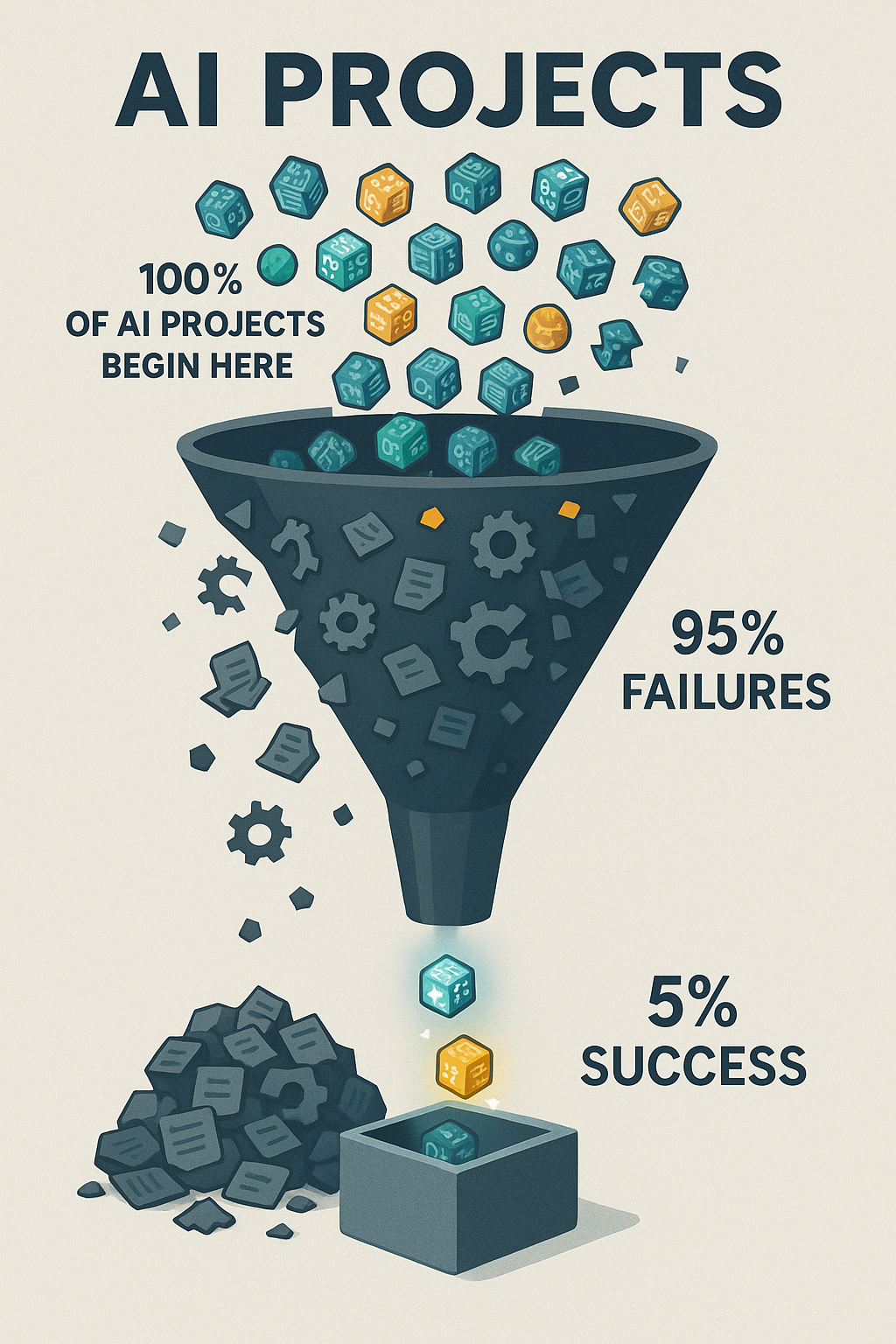
95% of AI Projects Fail. Don’t Let Your Call Center Be One of Them.
By now, you’ve probably heard the stat: 95% of AI projects fail. It’s been splashed across headlines and whispered in boardrooms ever since MIT’s 2024 study on enterprise AI adoption found that the vast majority of pilots fizzle before delivering measurable business value (MIT Sloan, Windows Central, The AI Navigator).
That failure rate isn’t just academic. It’s a warning sign for executives under pressure to “do something with AI.” Boards are demanding results, employees are skeptical, and customers are unforgiving when half-baked solutions make their experience worse. Nowhere is this pressure more acute than in call centers, where AI has been sold as the silver bullet to reduce costs and transform customer experience.
The problem? Most call center AI projects don’t even make it out of the pilot phase. The technology may be powerful, but when the rollout is rushed, misaligned, or poorly integrated, the results are predictable: frustrated employees, wasted budgets, and a public failure that makes the next project even harder to sell.
But here’s the thing—failure isn’t inevitable. A small percentage of organizations are already proving AI can make call centers faster, smarter, and more resilient. The difference isn’t the tools they buy. It’s how they implement them.
Only 5% of AI projects make it to success — a reminder of the challenges and discipline required to deliver real value.
This article will break down why so many call center AI projects fail, and more importantly, what you can do to ensure yours doesn’t.
The Real Reasons Behind the 95% Failure Rate
If we peel back the headlines, the real story behind AI’s 95% failure rate is that most projects collapse under the same set of avoidable mistakes. In call centers, the pressure to “do something with AI” often leads to rushed pilots, unclear success metrics, and cultural resistance long before the technology itself has a chance to prove value. To understand how not to become another cautionary tale, it’s worth starting with the most common—and most fatal—mistake: launching without a clear path to ROI.
1. No Clear ROI
Executives are under pressure to “do something with AI,” so projects often start for the wrong reasons: to appease a board, to follow competitors, or to run with a vendor’s shiny demo. But without a clear business case—shorter handle times, fewer escalations, lower attrition—pilots rarely connect to the P&L.
This is why so many projects stall out after the pilot phase. They look impressive in a slide deck, but when budget reviews come around, leaders ask the one question no one wants to answer: what value did this actually create? If the answer isn’t measurable, the project dies.
2. People and Culture Problems
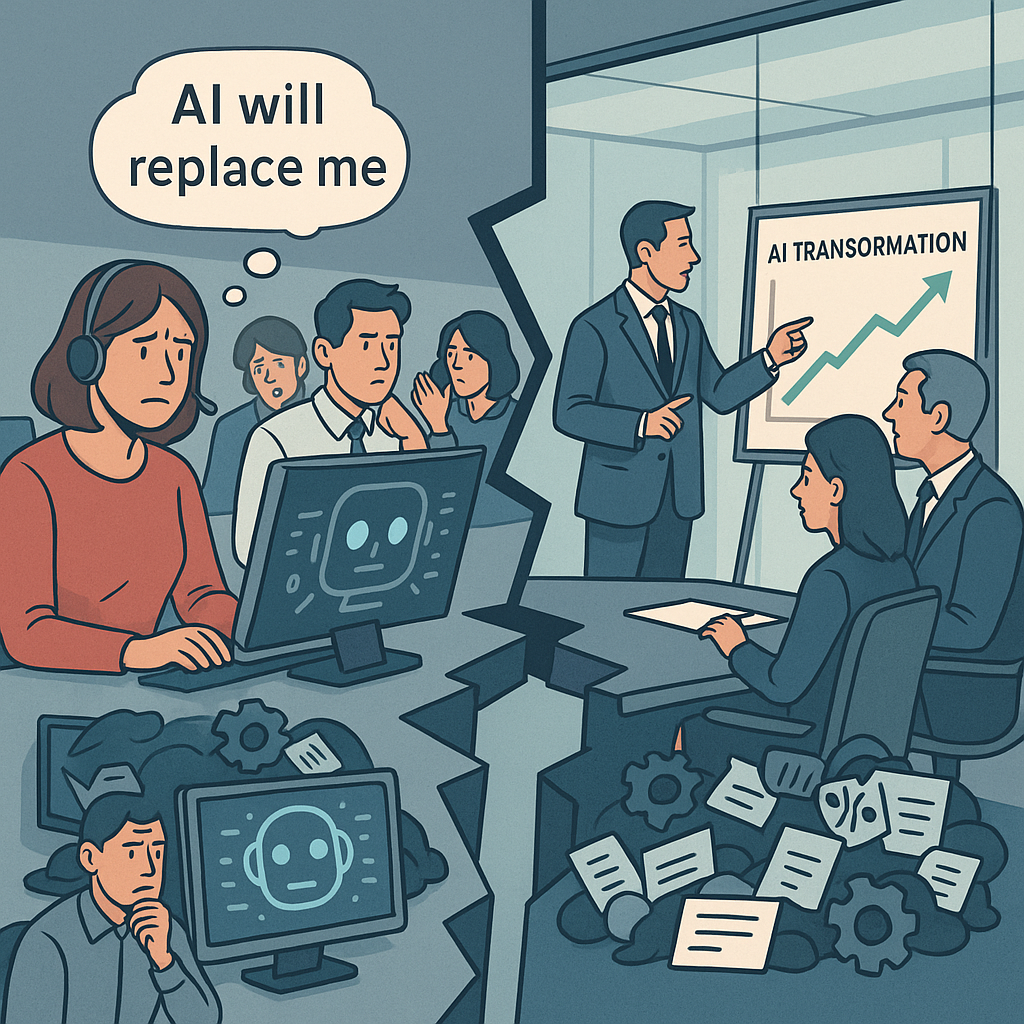
AI adoption isn’t just about technology—it’s about trust. Bridging the gap between leadership’s ambitions and employees’ readiness is the real transformation.
AI transformation doesn’t happen in a vacuum. It happens through people—and too often, people are an afterthought.
Agents see AI as a threat to their jobs. Managers see it as a top-down initiative they weren’t consulted on. And executives underestimate how much training, communication, and cultural readiness is required for adoption. The result? Resistance, slow uptake, and even outright sabotage.
A recent survey by Boston Consulting Group found that less than 20% of frontline employees feel confident using AI in their day-to-day work. If your people don’t understand it, trust it, or see “what’s in it for them,” no amount of investment will make it stick.
3. Broken Plumbing (Integration + Data)
AI isn’t magic—it runs on infrastructure. And in call centers, that infrastructure is notoriously complex. CRMs, telephony systems, workforce management tools, QA software… if the AI solution doesn’t plug into them seamlessly, it creates more friction than it solves.
Then there’s the data problem. Call centers produce mountains of data, but much of it is siloed, messy, or incomplete. “Garbage in, garbage out” isn’t just a cliché—it’s the reality. Poor data hygiene leads to bots giving wrong answers, analytics missing the mark, and employees spending more time cleaning up after AI than doing their actual jobs.
4. Misplaced Bets
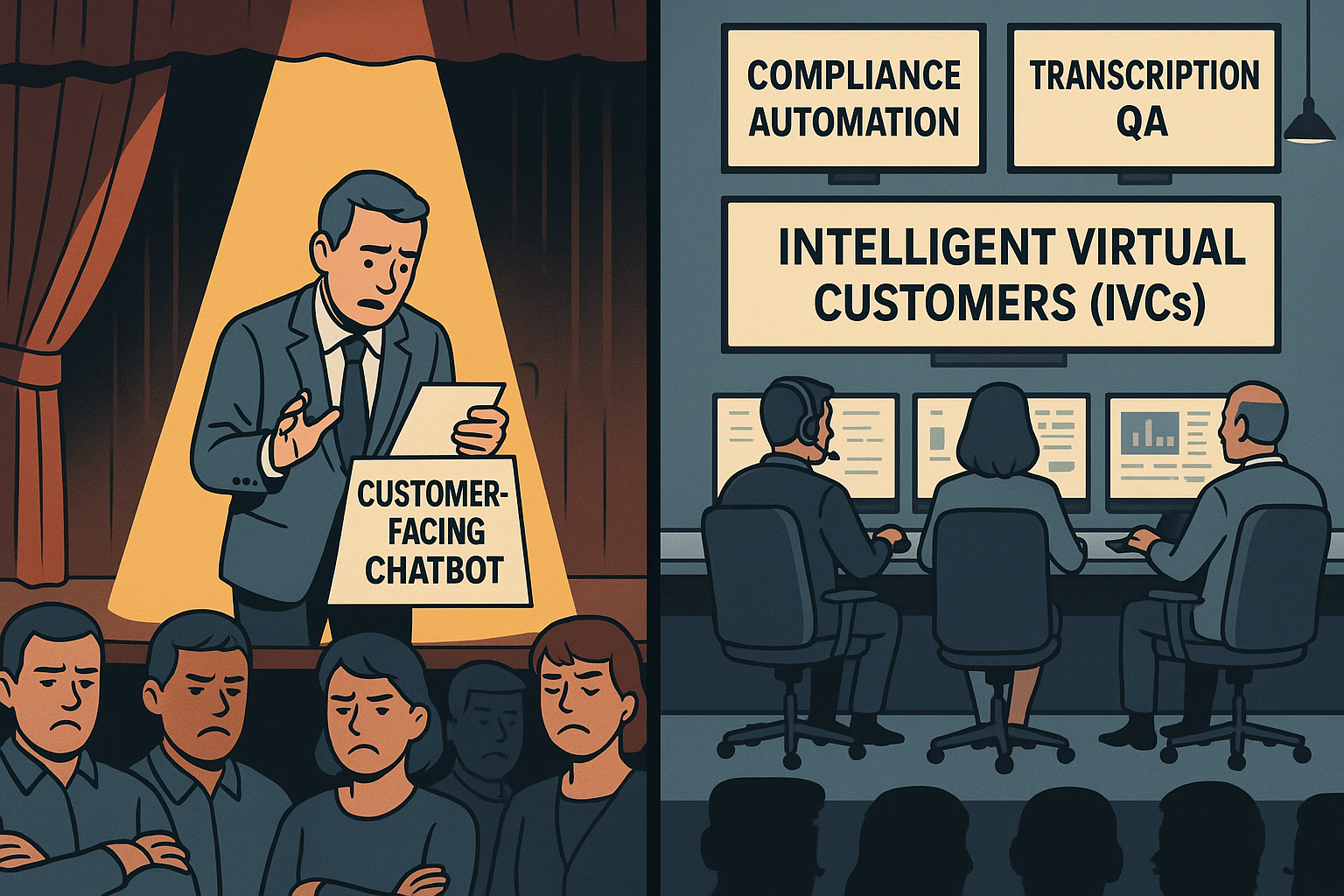
Finally, there’s the temptation to swing for the fences. Leaders want big, customer-facing wins—chatbots that deflect thousands of calls, or voice AI that handles entire conversations. The problem? These are the riskiest bets. Failures are public, employees lose trust, and customers are quick to share horror stories on social media.
Meanwhile, the boring stuff—back-office automation like compliance checks, call routing optimization, or transcript QA—quietly delivers reliable ROI. But because it’s less flashy, it often gets overlooked until budgets are burned and credibility is gone.
The Pattern
Call center AI projects don’t fail because the technology isn’t ready. They fail because organizations underestimate the cultural lift, overcomplicate the rollout, and bet on the wrong projects.
Until those fundamentals are addressed, AI will remain a boardroom talking point instead of a bottom-line driver.
Solutions: How to Avoid Being in the 95%
1. Reduce Variables: Start Small, Not System-Wide
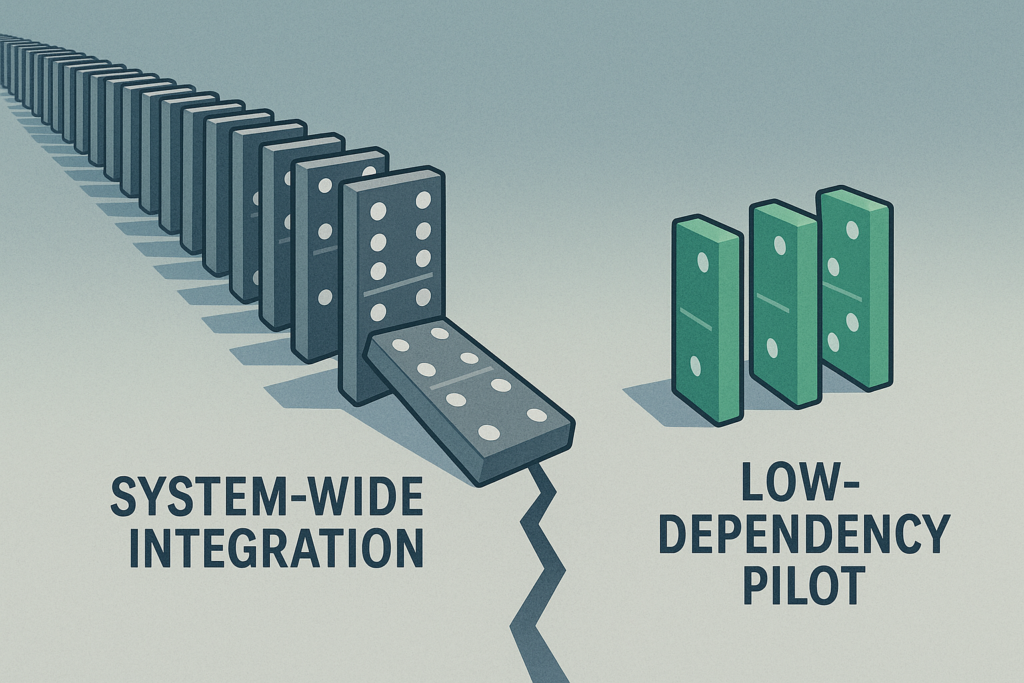
Simplify integration—launch where dependencies are low. The biggest AI failures are not due to the technology; they’re due to how organizations deploy it. Pulling off an enterprise-wide automation without ironing out integration and infrastructure first is a high-risk move guaranteed to detonate mid-flight.
A recent TechRadar Pro analysis labels this the “last-mile problem,” where grand digital transformation plans derail when hitting legacy systems, tangled data governance, and real-world constraints.
Big transformations carry big risks. Start small: a low-dependency pilot offers safety, control, and confidence before scaling.
The lesson: “implementation is strategy”—not just choosing the tech, but ensuring it works in practice.
Similarly, Gartner reports that a whopping 77% of engineering leaders say integrating AI into existing applications remains a major challenge, and advises selecting platforms with cohesive ecosystems rather than patching together disparate tools.
Where to start: low-dependency, high-ROI projects
Call Routing Automation Use AI to intelligently pre-route calls based on simple metadata (region, priority, agent skill set), which often requires minimal CRM integration but delivers clear impact on handling times and customer experience.
Workforce Scheduling Support Implement AI assistants that leverage historical patterns for smarter shift assignments or adherence monitoring—again, typically interacting only with workforce management modules, not full CRM pipelines.
Quality Assurance Automation Instead of automating agent-facing scripts or customer interactions, choose an internal process—like analyzing call transcripts for compliance or sentiment—that runs independently and delivers immediate insight and ROI.
Select initial projects with low system coupling—components that can run nearly standalone or work within well-defined scopes. These “minimum viable integrations” reduce complexity while proving value in real business terms.
2. Build Employee Buy-In Early
From skepticism to empowerment: Make AI feel like a help, not a threat.
Set the Stage with Data
Employee sentiment around AI adoption is fraught with concern. A recent GoTo survey found that 62% of employees believe AI is significantly overhyped, and 86% admit they aren’t using it to its full potential—mainly because they lack confidence in how or where it fits into their day-to-day work.
Meanwhile, a Pew Research Center study shows that only 16% of workers use AI at all, and a staggering 80% do not—highlighting a gap between access and adoption.
These trends reveal a hidden truth: resistance isn’t about stubbornness—it’s about uncertainty.
Focus: Education Before Automation
Instead of positioning AI as a replacement, frame it as a tool that makes agents’ lives easier. Provide contextual training tailored to real workflow scenarios, and walk through how AI can reduce mundane tasks—like auto-sorting inbound calls or flagging compliance breaches—not replace human judgment.
Pilot with Employee Champions
AI adoption spreads best through peer advocacy, not top-down mandates. Identify a group of motivated agents—trusted individuals who are curious and coachable—and involve them early. They act as localized influencers: shaping adoption norms, providing feedback, and demonstrating AI’s value in their own workflows. This grassroots approach builds momentum from the frontline upward.
Build Trust Through Communication
Trust in leadership strongly influences trust in AI. A Harvard Business Review insight underscores that employees are skeptical about AI when they don’t trust the leadership behind it—especially if they feel AI is being used without transparency or benevolent intent.
Open dialogue about AI’s role, limitations, and safety—tracks not just outcomes, but message clarity—makes adoption feel intentional, not imposed.
3. Automate the Back Office First
Minimize risk—let quiet wins build credibility.
While chatbots struggle in the spotlight, behind-the-scenes automation drives efficiency and reliability.
“Automate the back office first” may sound like an overused mantra, but it’s popular for a reason: starting where AI has fewer customer-facing risks gives organizations the breathing room to prove ROI without the PR nightmare of a failed chatbot rollout.
Back-office functions—compliance, transcription QA, performance analytics, and Intelligent Virtual Customers (IVCs)—are ideal launchpads. They’re process-heavy, measurable, and less exposed to the customer’s direct line of sight.
What to Automate First
Compliance Checks: Automate auditing call transcripts to flag regulatory or policy issues.
Transcription QA: Use AI to analyze recordings for accuracy, sentiment, or script adherence.
Performance Analytics: Spot patterns in agent productivity, escalation trends, or customer sentiment shifts.
Intelligent Virtual Customers (IVCs): Synthetic customers designed to simulate real conversations. Instead of risking failure with live customers, IVCs let you test, train, and refine AI models against realistic scenarios—quietly, safely, and cost-effectively.
Case in Point: Commonwealth Bank’s Cautionary Tale
When Australia’s Commonwealth Bank (CBA) pushed AI voice bots directly into customer service, the outcome was public and painful. Bots failed to resolve issues, call volumes rose, and 45 jobs were cut prematurely before the bank had to backpedal amid backlash.
It’s a textbook example of chasing a headline instead of proving AI’s value in safer, internal domains first.
Why It Works
Low visibility = low risk: Errors happen behind the scenes, not in front of customers.
Proof of value: Automating “boring but critical” processes shows real, measurable ROI.
Foundation for scale: Early wins build executive and employee confidence for more ambitious rollouts.
4. Vendor Strategy: Safe Bet vs. Fast Bet
Choosing the right partner can make or break your AI project.
Option 1: Incumbent Vendors — The Safe Bet
Large, established vendors (think your existing CRM, workforce management, or cloud providers) come with undeniable advantages: scale, security, and the credibility that reassures your board. They’ve delivered before, and they’ll integrate into your existing tech stack with less friction.
The trade-off? Speed. Big vendors often move slowly, layering AI into their products incrementally. You’ll sacrifice agility for stability—but for some executives, especially those under scrutiny from boards or regulators, that’s the right call.
Option 2: Startups — The Fast Bet
Smaller, specialized vendors often innovate faster. They can spin up pilots in weeks, customize deeply for niche workflows, and push the boundaries of what’s possible with AI.
But there are risks: limited resources, unproven scalability, and the potential for hiccups that frustrate employees or erode credibility with customers. A failed startup partnership can set your AI agenda back years—not because the tech was bad, but because your organization loses confidence.
Vendor Strategy: Safe Bet vs. Fast Bet
Factor
Incumbent Vendor (Safe Bet)
Startup Vendor (Fast Bet)
Speed to Deploy
Slower, incremental rollout
Fast, agile pilots
Integration
Strong alignment with existing stack
Flexible, but may require workarounds
Credibility with Board
High — proven track record
Mixed — depends on reputation
Risk of Failure
Low technical risk, slower ROI
Higher risk of hiccups, potential setbacks
Innovation
Steady, but rarely disruptive
Cutting-edge, niche solutions
Scalability
Enterprise-grade, reliable
May struggle at large volumes
Best Fit When…
Board/regulators demand stability; credibility matters most
Speed and differentiation are critical; appetite for risk is higher
Hybrid Strategy
Use for customer-facing or mission-critical AI
Use for back-office pilots and innovation sprints
The Executive Framework: Choosing Your Path
When deciding between safe and fast, align the choice to your risk appetite and board expectations:
If credibility matters most: Stick with incumbents. They provide a defensible, low-risk path to AI adoption.
If speed and differentiation are critical: Partner with startups. Be ready to embrace hiccups as the price of innovation.
If you want both: Consider a hybrid strategy—pilot with a startup in the back office (low risk, high learning), while aligning your customer-facing roadmap with a trusted incumbent.
Bottom line: There’s no “right” choice, only the choice that fits your strategic posture. The wrong vendor isn’t just a missed opportunity—it can turn your call center into another 95% statistic.
Executive Playbook: Making Call Center AI Work
AI success in call centers isn’t about chasing the flashiest tools. It’s about discipline, focus, and choosing battles you can win. Here’s the checklist every executive should keep in mind before greenlighting the next AI project:
✅ Tie Every Pilot to Measurable ROI
If you can’t connect the project to the P&L, don’t start it. Define success upfront in hard metrics: reduced handle time, lower attrition, higher CSAT, or compliance cost savings. Every pilot should answer the board’s question: “What business value did this create?”
✅ Pick “Low Surface Area” Projects First
Start where integration is simplest and dependencies are minimal. Call routing, workforce scheduling, and QA automation deliver quick wins without touching every system in the stack. Prove value before attempting system-wide transformations.
✅ Train Employees and Align Incentives
AI doesn’t work if people won’t use it. Invest in education that shows employees how AI helps their workflows, not replaces them. Reward early adopters, celebrate quick wins, and use employee champions to spread momentum.
✅ Prioritize Back-Office Before Customer-Facing
Public-facing AI failures destroy credibility fast. Back-office automation—compliance checks, transcription QA, performance analytics, Intelligent Virtual Customers (IVCs)—delivers ROI quietly while giving you space to refine the technology.
✅ Match Vendor Choice to Risk Appetite
Don’t let vendor selection be an afterthought. If stability and credibility matter most, lean on incumbents. If speed and differentiation are critical, partner with startups. Better yet, build a hybrid strategy: use startups for low-risk pilots, then scale with trusted incumbents.
The Bottom Line
AI projects succeed when leaders treat them as business initiatives, not tech experiments. Anchor every step in ROI, simplify your first moves, bring employees along for the ride, and choose vendors with your strategic posture in mind. Do this, and your call center won’t just avoid being part of the 95%—it will help define the playbook for the 5%.
TLDR; The 5% Opportunity
The numbers may be grim—95% of AI projects fail—but they’re not destiny. For call centers, success isn’t about betting on the flashiest AI or rushing to impress the board with a chatbot demo. It’s about focus, realism, and cultural readiness.
The difference between the 95% that fail and the 5% that succeed isn’t the technology. It’s leadership. Leaders who demand measurable ROI, start small, bring employees along, and place smart vendor bets are already proving AI can make call centers more efficient, resilient, and customer-centric.
As an executive, you don’t have the luxury of treating AI as an experiment. Your job, your team, and your customer experience depend on getting it right. The good news: you can get it right—if you build deliberately, not reactively.
So here’s the call to action: Don’t chase the hype. Build the foundation that makes your call center part of the 5%.
From Hire to High-Performer: 3 AI-Powered Tactics to Streamline Recruiting, Onboarding & Training
AI turns hiring chaos into clarity—cutting through the noise to surface the best-fit candidates, fast.
It starts with a flood.
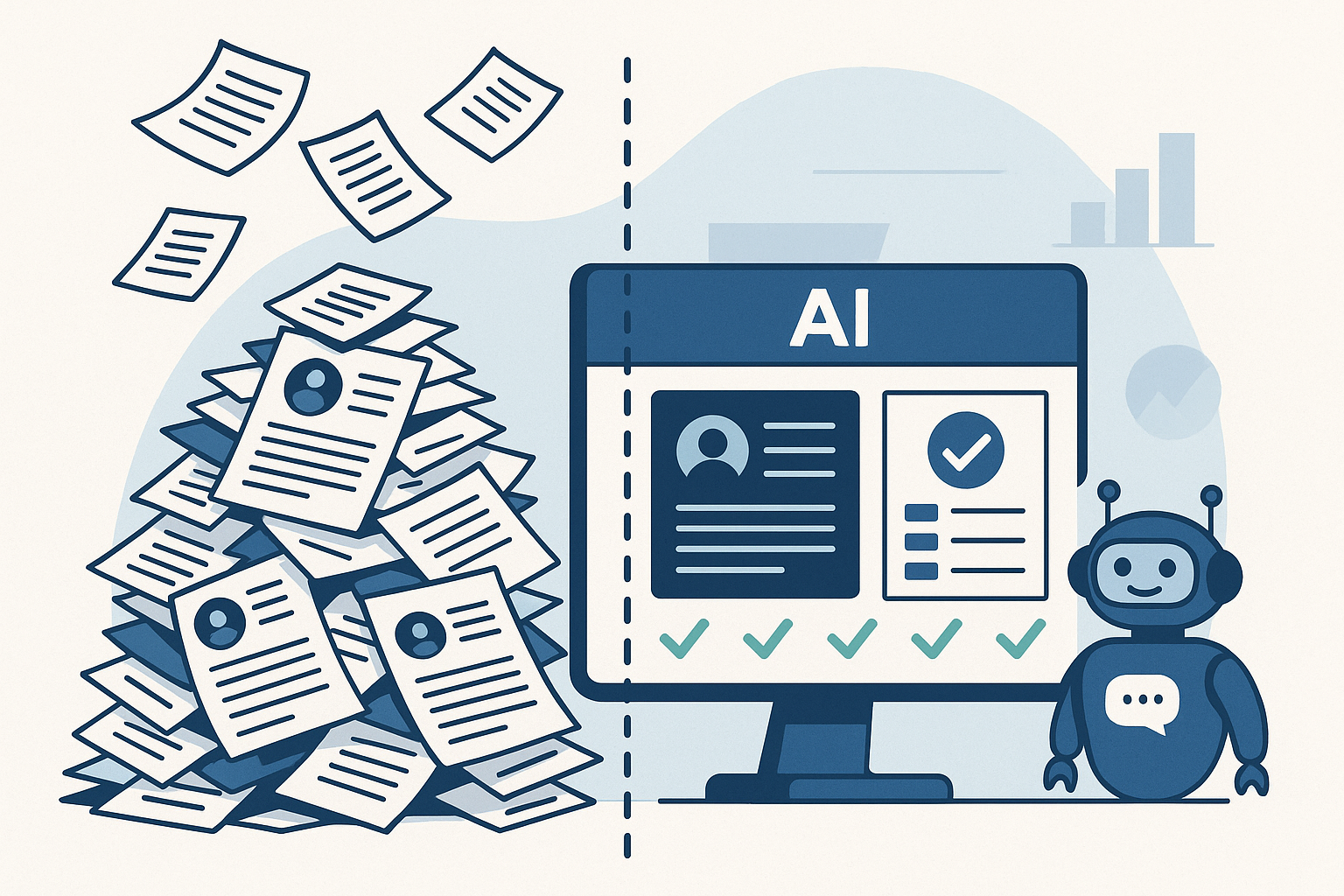
You post a job, and hundreds of resumes roll in overnight. But instead of being a dream scenario, it’s a nightmare. Half the applicants are unqualified. The other half blur together in a sea of keyword-stuffed documents. Weeks go by, and your hiring managers are still stuck in interviews—while your top candidates have already accepted offers elsewhere.
You’re not alone. The average time to hire in tech is now 44 days, up 18% from just two years ago (LinkedIn, Future of Recruiting).
Meanwhile, AI-powered resume tools have flooded applicant pools with noise, not clarity.
Then comes onboarding. Or rather, the lack of it.
Your new hire arrives eager, but hits a wall of fragmented systems, outdated documents, and generic training that fails to reflect their role, region, or readiness. What should feel like a launchpad feels more like a holding pattern. And for many, that friction leads to early disengagement—or even departure. In fact, 28% of new hires quit within the first 90 days (Jobvite, Job Seeker Nation Report).
And when it comes to training? Most programs are reactive, not proactive. Learning is disconnected from live performance, and managers don’t realize there’s a skill gap until it shows up in a customer call, a missed target, or a costly error. Only 12% of employees say they actually apply what they learn in training to their day-to-day job (HR Dive, Training ROI Study).
From bloated recruiting cycles to onboarding that doesn’t onboard, and training that’s too little too late—talent systems are stuck in the past.
It’s time for a smarter approach.
In this blueprint, we’ll show how AI can transform the journey from hire to high-performer—cutting through the noise, connecting the dots, and delivering measurable impact at every stage.
1. AI in Recruiting: Speed, Fairness & Fit
Meet Alex, Head of Talent Operations at a national health tech provider. His challenge wasn’t a lack of applicants—it was keeping the right ones engaged long enough to show up for Day One.
They were hiring contact center agents—high-turnover, high-pressure roles where time-to-hire wasn’t just a metric—it was the make-or-break variable. Coordinating start dates, managing candidate drop-off, and keeping hiring classes full was a weekly fire drill.
“We’d lose half our candidates before we could even get them scheduled,” Alex said. “Sometimes we were planning a training class on Monday and still didn’t have confirmations by Friday.”
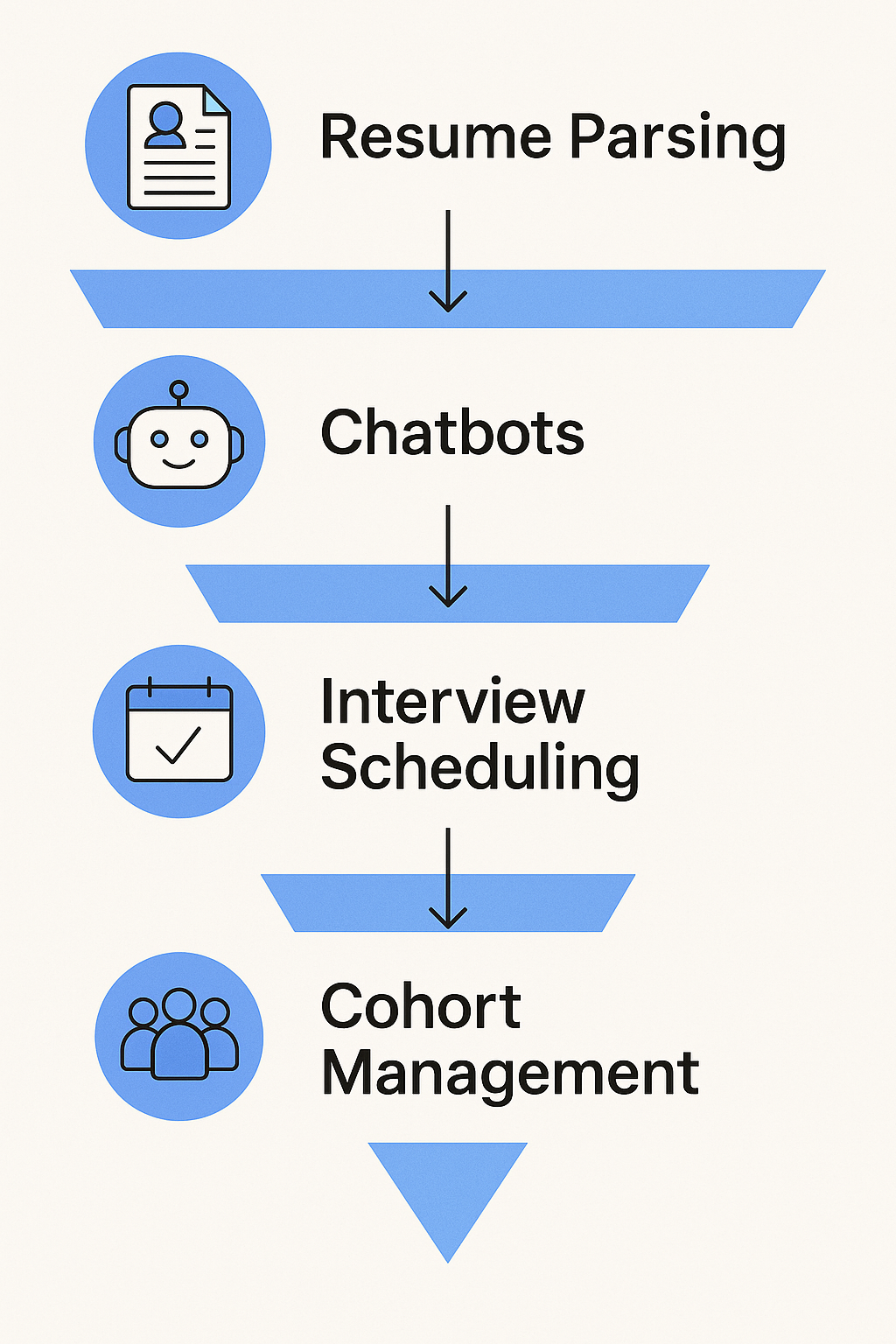
AI simplifies recruiting—from resume overload to cohort-ready candidates—with automation at every step.
He’s not alone. According to Reccopilot, 57% of candidates lose interest if they don’t hear back within two weeks. In high-volume roles, that window is often tighter—measured in days, not weeks.
So, Alex’s team turned to AI—not to automate away the human element, but to remove friction and speed up handoffs:
Instant resume screening helped triage hundreds of applicants daily, surfacing candidates who actually met licensing and shift requirements.
Automated outreach and SMS nudges kept candidates engaged with next steps, without manual follow-up.
Calendar-syncing AI tools allowed candidates to self-schedule interviews within hours of applying.
Once a hiring class was full, the system immediately closed the posting and adjusted the funnel for the next cohort—no spreadsheet gymnastics required.
By layering in AI, Alex’s team didn’t just shave days off the process—they reclaimed control over start date planning. They could fill classes faster, reduce no-shows, and proactively balance capacity with demand.
And most importantly, recruiters got back to what mattered: building trust, answering real questions, and moving fast on people who were ready to work.
Summary Table: What AI Handles Today
AI Feature
What It Does
Resume Screening
Parses files, ranks by role fit
Chat & Voice Bots
Engages, asks questions, delivers interview links
Interview Scheduling
Syncs calendars, sends invites, sends reminders
Bias Mitigation
Anonymizes applications, flags biased job wording
Predictive Matching
Recommends best-fit candidates based on data
2. AI in Onboarding: Turning Offers into Ready, Reliable Agents
Continuing Alex’s journey at the health tech provider, the team faced a new challenge after fast hires: getting contact center agents to actually show up—and stay past Day One.
With hires dropping out during paperwork or losing momentum before their start date, Alex knew onboarding needed a transformation.
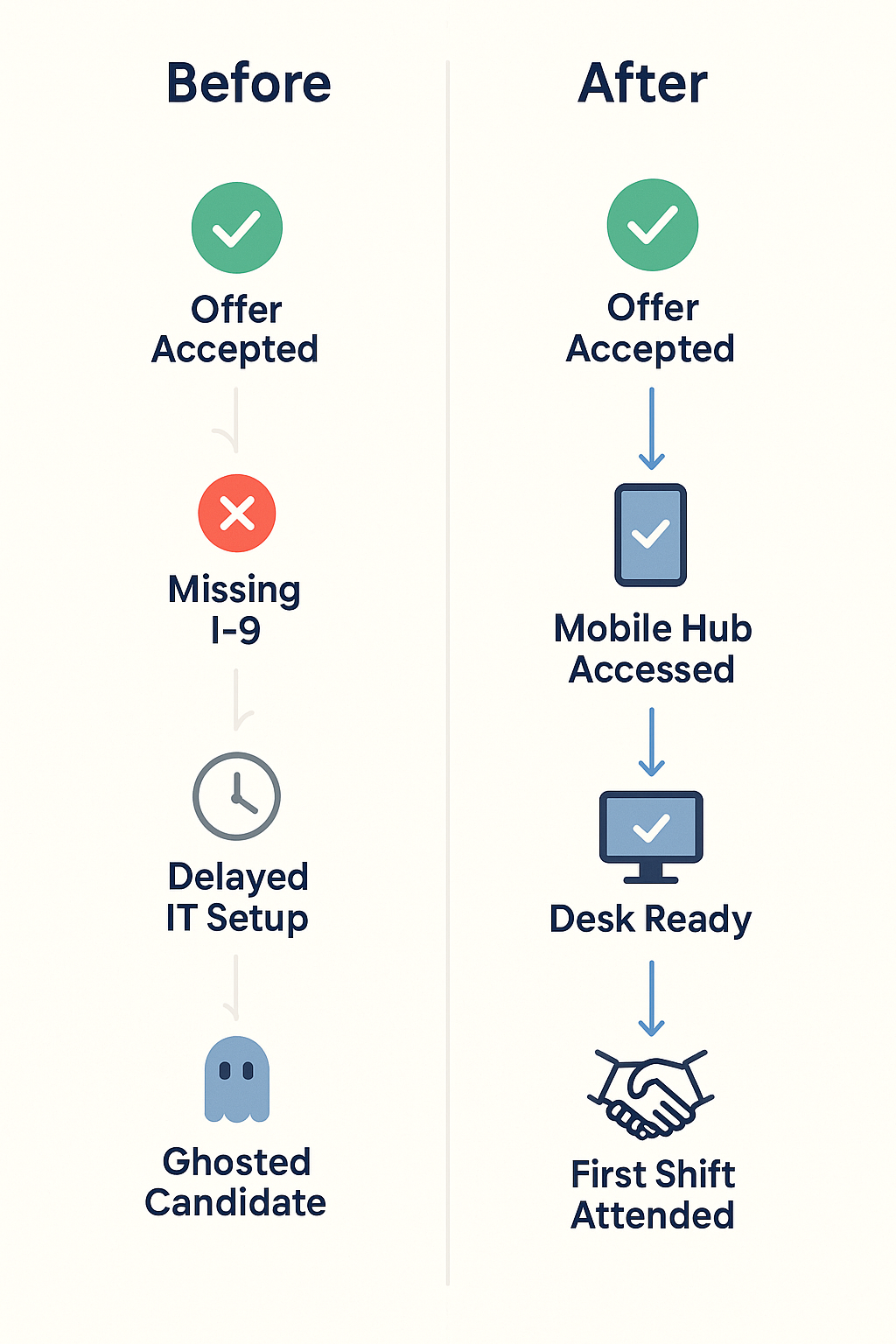
“We’d get them on the schedule, but then chaos hit—lost forms, late IT access, and stale communication,” he explained. “It wasn’t surprising that candidates ghosted before their first shift.”
They needed speed, precision, and seamless coordination. Enter AI-powered onboarding.
How AI reshaped onboarding for contact center heads:
Automated workflows triggered IT setup, desk access, and training enrollment instantly once an offer was accepted—no more manual handoffs.
Smart reminders for forms like I‑9s and W‑4s meant nothing fell through the cracks before Day One.
Personalized onboarding hubs on mobile and desktop gave new agents a clear schedule, video intros, and orientation steps tailored to their role and start date.
Proactive engagement analytics flagged inactivity (e.g., no logins, unsigned docs), prompting recruiters to reach out before the candidate slipped away.
From delays to Day One success—AI turns onboarding friction into a reliable, mobile-first experience.
About 22% of job seekers don’t show up on Day One—but mobile-first, automated onboarding experiences dramatically reduce that risk (SafetyCulture Training).
69% of employees are more likely to stay for three years when they experience a strong onboarding program (appical).
The outcome:
For Alex’s team, these changes made a measurable impact:
Onboarding no-shows dropped by 22%—equivalent to nearly one out of every five new hires now walking through the door.
Agents were operational 40% sooner, ready to take calls earlier and with better confidence.
HR was freed from tracking systems to coach and support with purpose—not just nag.
Alex reflected: “AI didn’t just automate tasks—it brought clarity and kept people engaged when it mattered most.”
3. AI in Training: Personalized, Data-Driven Enablement
Alex’s turning point: bridging the gap between training and real-world readiness.
By the time new contact center agents wrapped onboarding, Alex finally had momentum. No more no-shows. Fewer early exits. His hiring classes were full and engaged.
But one question still kept him up at night:
“How do I know who’s actually ready to talk to a customer?”
Some agents sounded sharp in training but floundered live. Others passed quizzes but froze under pressure. And when readiness is unclear, every new hire is a gamble—risking CSAT scores, team morale, and customer trust.
That’s where AI flipped the script—from reactive to predictive.
Alex partnered with his Enablement and Ops leaders to implement AI-powered training diagnostics—not just to deliver content, but to predict agent performance before go-live.
How it worked:
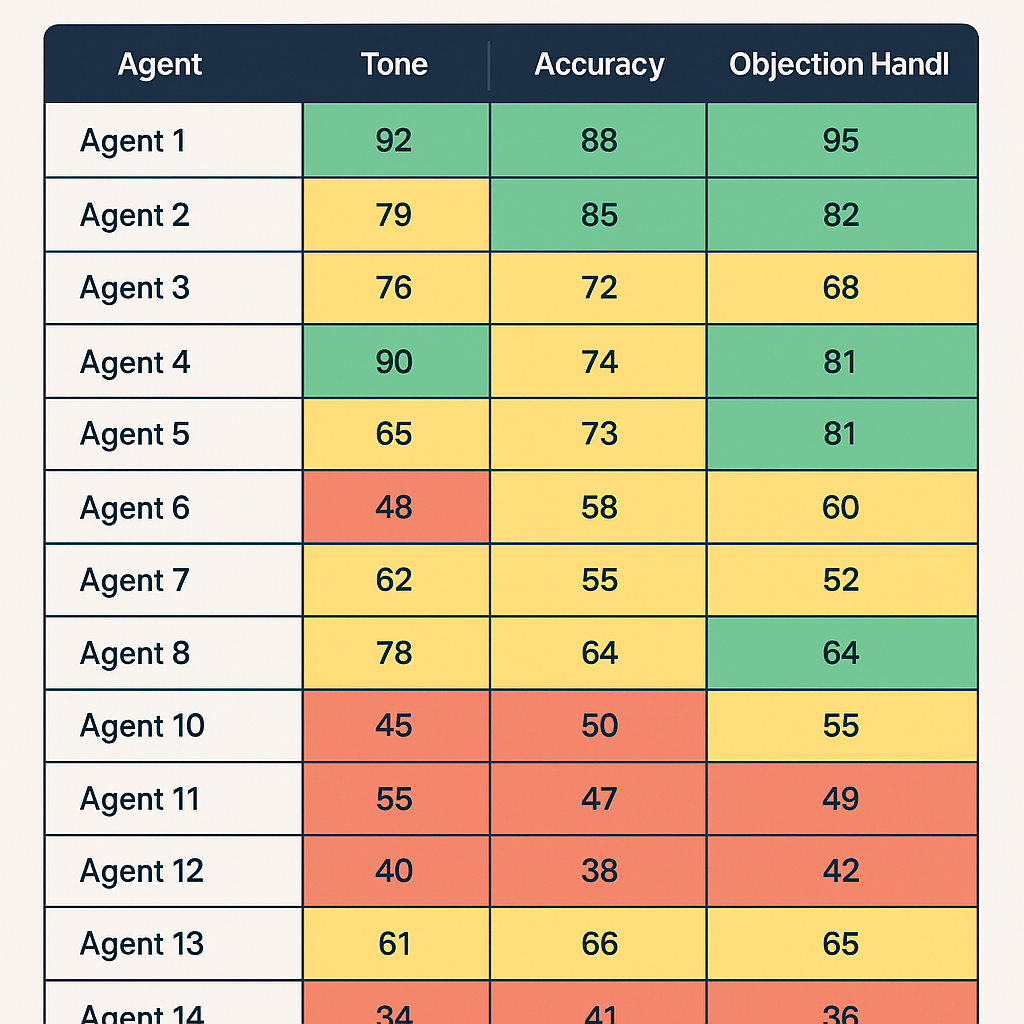
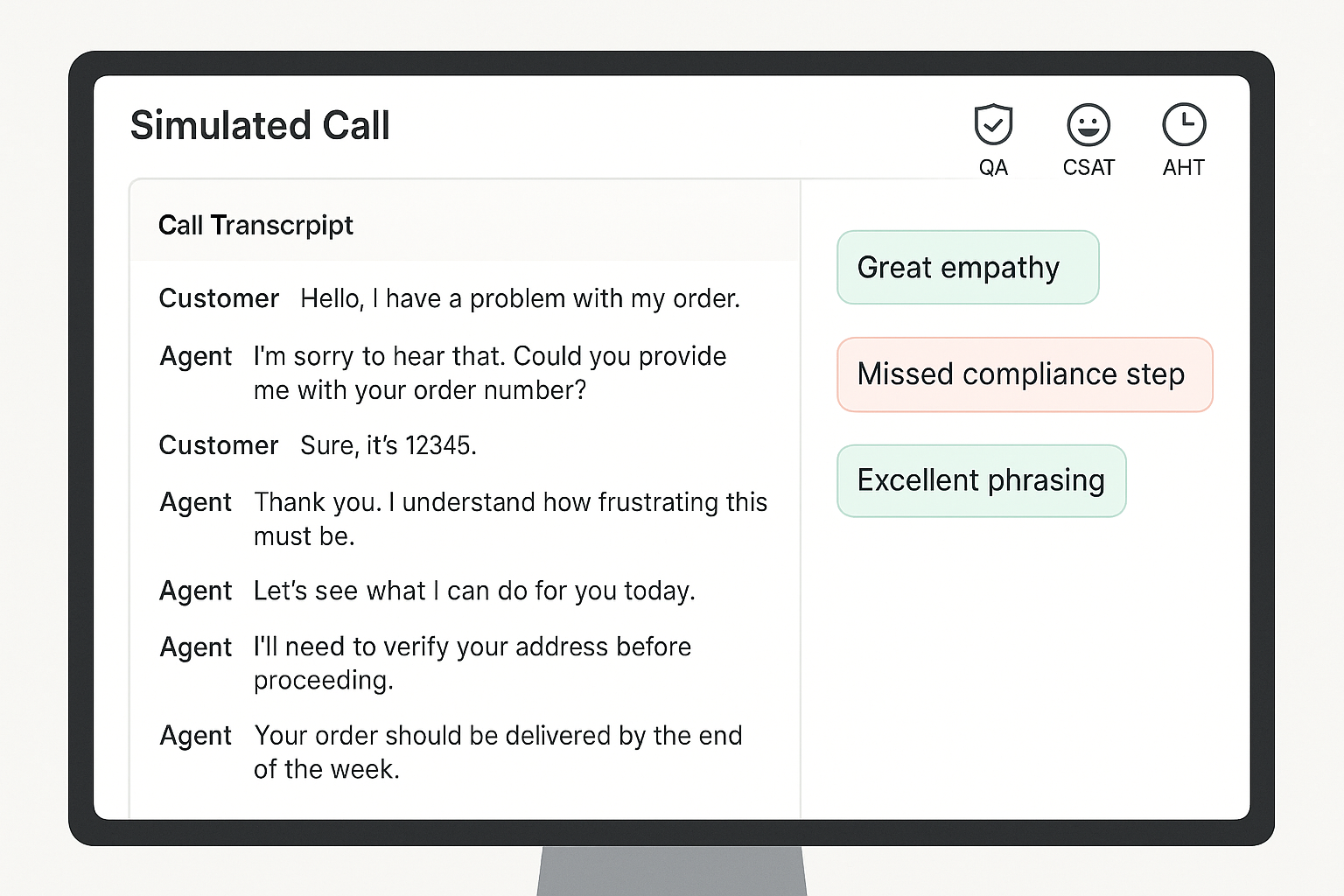
Simulated call environments gave new reps scenario-based roleplays that mirrored real customer issues. AI analyzed tone, timing, accuracy, and emotional response.
Live behavioral scoring surfaced patterns that humans might miss—hesitation on compliance topics, inconsistent empathy language, or procedural missteps.
Predictive readiness scores were generated for each rep, combining quiz data, practice call performance, and learning behavior to estimate live call success.
Managers received risk indicators before go-live: “Rep A needs more time on de-escalation,” or “Rep B shows high readiness for billing scenarios but missed security steps.”
The result?
“We stopped guessing,” Alex said. “We knew who was ready—and who needed coaching—before customers were on the line.”
Measuring Effectiveness, Not Just Completions
With traditional LMS systems, success = 100% module completion. But completion isn’t capability.
With AI-enabled training tools like TrueCX, Alex’s team went beyond checkboxes:
Correlating training to outcomes: TrueCX mapped onboarding experiences to early KPIs like call handle time, escalation rate, and QA scores.
Identifying curriculum gaps: When reps consistently missed the mark on certain call types, TrueCX flagged the module responsible—turning lagging metrics into coaching opportunities.
Delivering precision coaching: Instead of mass refreshers, Alex’s enablement team delivered targeted reinforcement—one micro-module per rep, per skill gap.
The Impact:
Ramp-to-performance time dropped by 30% for new hires with predictive diagnostics (Learning Guild, 2025).
Teams using AI to link training with performance saw 15–20% improvements in CSAT and first-call resolution, especially in healthcare, telecom, and finance sectors (McKinsey, 2024).
And perhaps most importantly: Alex now had a defensible, data-driven answer when senior leadership asked, “Is our training actually working?”
Conclusion: Future of Work = AI‑Augmented, Not AI‑Replaced
Alex’s journey—from chaotic hiring cycles to confident, call-ready agents—wasn’t about replacing people. It was about freeing people up to do what they’re best at.
AI handled the noise:
The resume flood
The pre-Day-One paperwork chase
The uncertainty around training readiness
What it gave back was clarity.
Recruiters focused on conversations—not scheduling. Onboarding teams supported people—not forms. Enablement coached for performance—not just completions. And new hires showed up engaged, prepared, and confident.
That’s the promise of AI across the talent lifecycle: not a shortcut, but a smarter, more connected way to scale the human side of your operation.
The teams seeing real transformation aren’t throwing tools at every problem. They’re starting with the pain point that’s costing them most—hiring delays, no-shows, or inconsistent ramp—and solving that with precision. Then expanding from there.
Start small. Start where it hurts. And build a system that helps people do what they do best—better.
Because high-performance teams don’t just happen. They’re built—one insight, one system, one teammate at a time.
You don’t need to overhaul everything overnight—but you do need to start. Pick the one place where friction is highest—hiring delays, onboarding chaos, or training that doesn’t translate—and ask:
Where could AI remove the noise so your people can focus on what matters?
The teams that win aren’t waiting for perfect. They’re starting small, learning fast, and building smarter—one system at a time.
Ready to explore what that could look like in your org? We’d love to help you think it through.
Hiring contact center agents at scale is a race against time—and attrition. Nearly 57% of candidates lose interest if they don’t hear back within two weeks, and 22% of new hires never show up on Day One. For Alex, a Talent Ops leader at a high-growth health tech company, those numbers were more than statistics—they were weekly crises.
This article follows Alex’s transformation from firefighting to forecasting. By applying AI across recruiting, onboarding, and training, his team slashed hiring delays, dropped no-shows by over 20%, and cut ramp time by 30%—all while improving rep performance and retention.
Through smart automation, predictive training insights, and connected data, AI helped Alex’s team stop managing chaos and start building a workforce that was truly ready on Day One—and equipped to stay. If you’re scaling high-turnover roles, this is how you build the engine.
5 Ways to Improve Call Center Onboarding Without Slowing Down Ops
New Reality: AI Is Redefining Call Center Onboarding
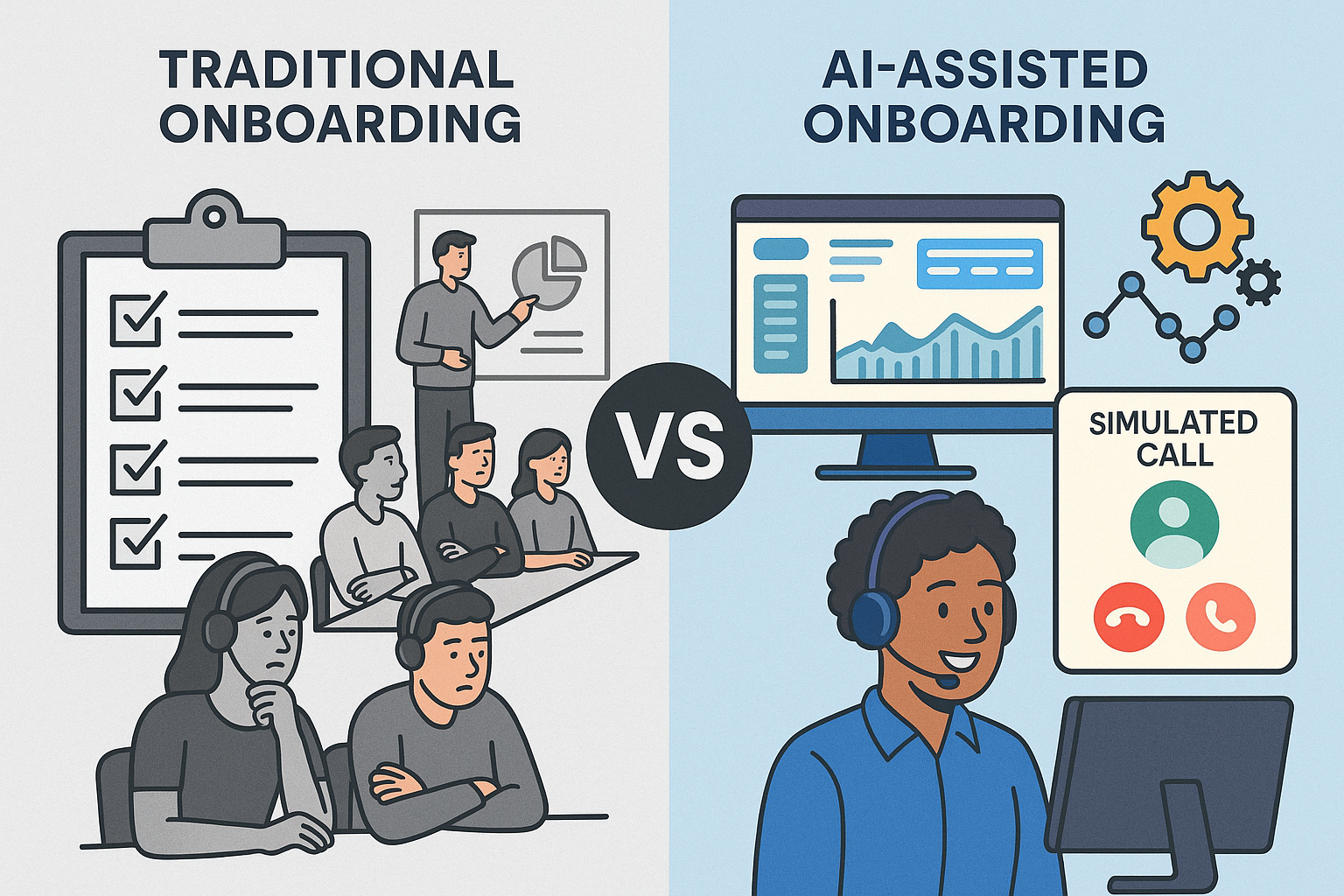
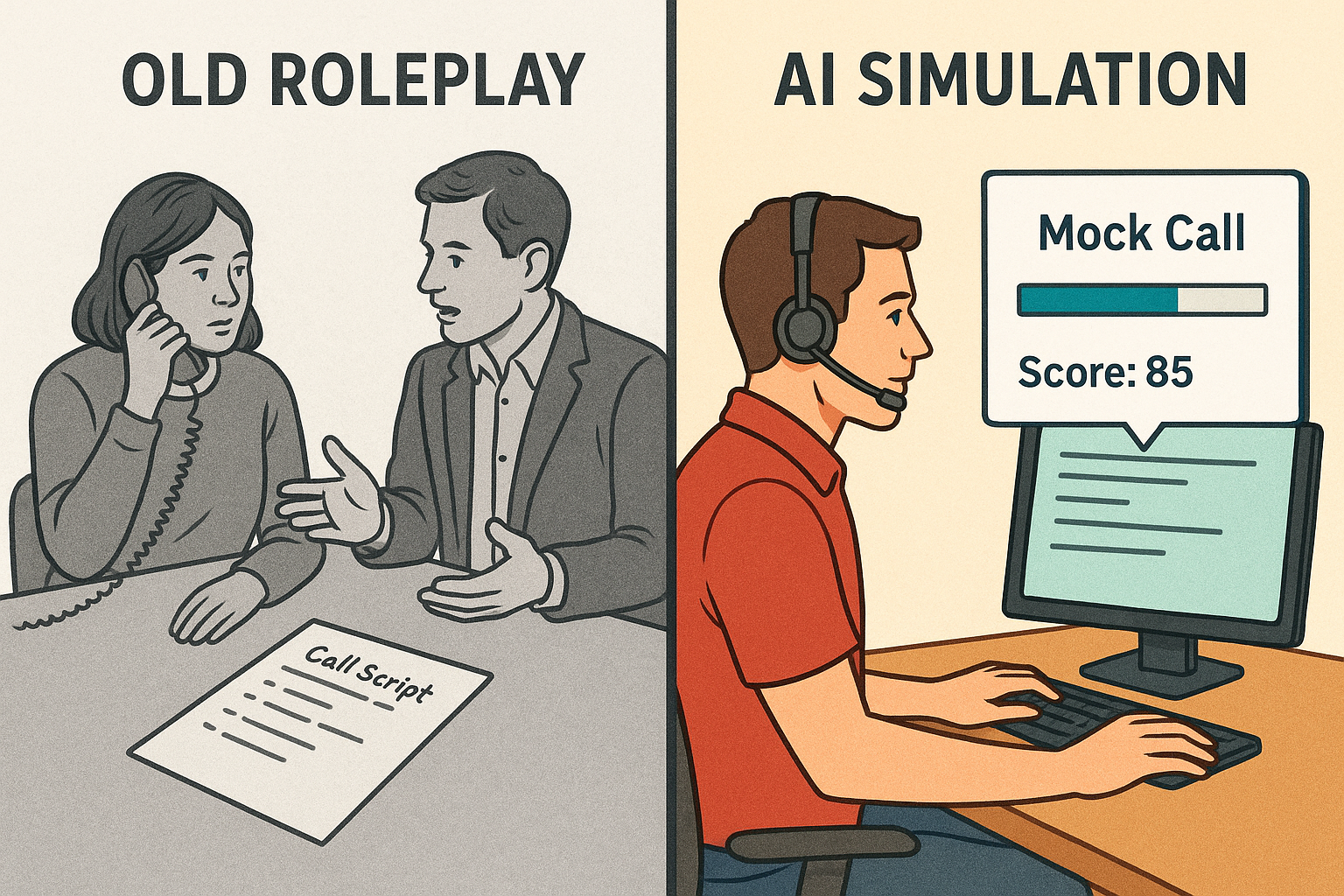
Contrasting outdated onboarding methods with modern AI-enhanced training in call centers.
Today’s contact center leaders face a balancing act: ramp agents faster, improve call quality, and avoid disrupting daily operations.
But traditional onboarding hasn’t kept up. Lengthy classroom sessions, inconsistent roleplay, and slow feedback loops are still common — even though they rarely translate into better performance.
And that gap is costly. According to McKinsey, high-performing agents are up to 3x more productive than low performers. Meanwhile, ICMI reports that 62% of contact centers take more than two months to fully onboard a new agent. That’s too long.
The opportunity? AI-powered onboarding that lives in the back office. You can safely optimize training where it won’t affect customers — giving your team faster ramp times, better data, and more control.
1. Identify High and Low Performers Early
The earlier you can separate high-potential hires from poor fits, the better. Early training is your chance to assess not just skills, but coachability — a leading indicator of long-term success.
Many leaders hesitate to cycle out low performers too soon. But dragging them through onboarding can waste thousands in time and wages, while slowing your coaches down.
Action Tip:
In the first week, score mock calls using a rubric with clear categories: product accuracy, tone, active listening, and objection handling. Use this data to tag coachable agents for fast-tracking, and move on quickly from those who aren’t progressing.
2. Track Performance Before the First Real Call
Your first live call shouldn’t be the first time you assess an agent’s skills.
Without early benchmarks, it’s impossible to know who’s ready — or what good looks like. That’s why simulated performance tracking is key.
Leading teams are using AI-powered roleplay and simulation to measure call handling, QA adherence, and even mock CSAT before agents hit the floor. This reduces the chance of bad first impressions with customers.
Action Tip:
Use virtual customers to simulate key scenarios during onboarding. Track how each rep performs on scripted calls, objections, compliance, and empathy. Benchmark performance across day 1, week 1, and week 4.
3. Make Practice Safe, Frequent, and Feedback-Rich
From manual practice to measurable progress: how AI is transforming call training.
Live roleplays are useful, but they’re often inconsistent. One coach might give thorough feedback while another lets agents skate by. Worse, they’re time-consuming.
Practice needs to be low-risk, repeatable, and paired with instant feedback. AI makes this possible. Simulated calls can happen anytime, anywhere, and every interaction can be scored against consistent standards.
Action Tip:
Replace ad hoc roleplay with structured simulations powered by virtual customers. Layer in automated scoring and feedback, so agents always know what to fix. Aim for 3–5 short simulations per module, with a minimum passing score required to move on.
4. Optimize for Your Fastest Rampers
A Salesforce study found that shortening ramp time by just 10% led to a 12% increase in agent productivity. Source
Most onboarding is designed for the average hire. That drags down your timeline.
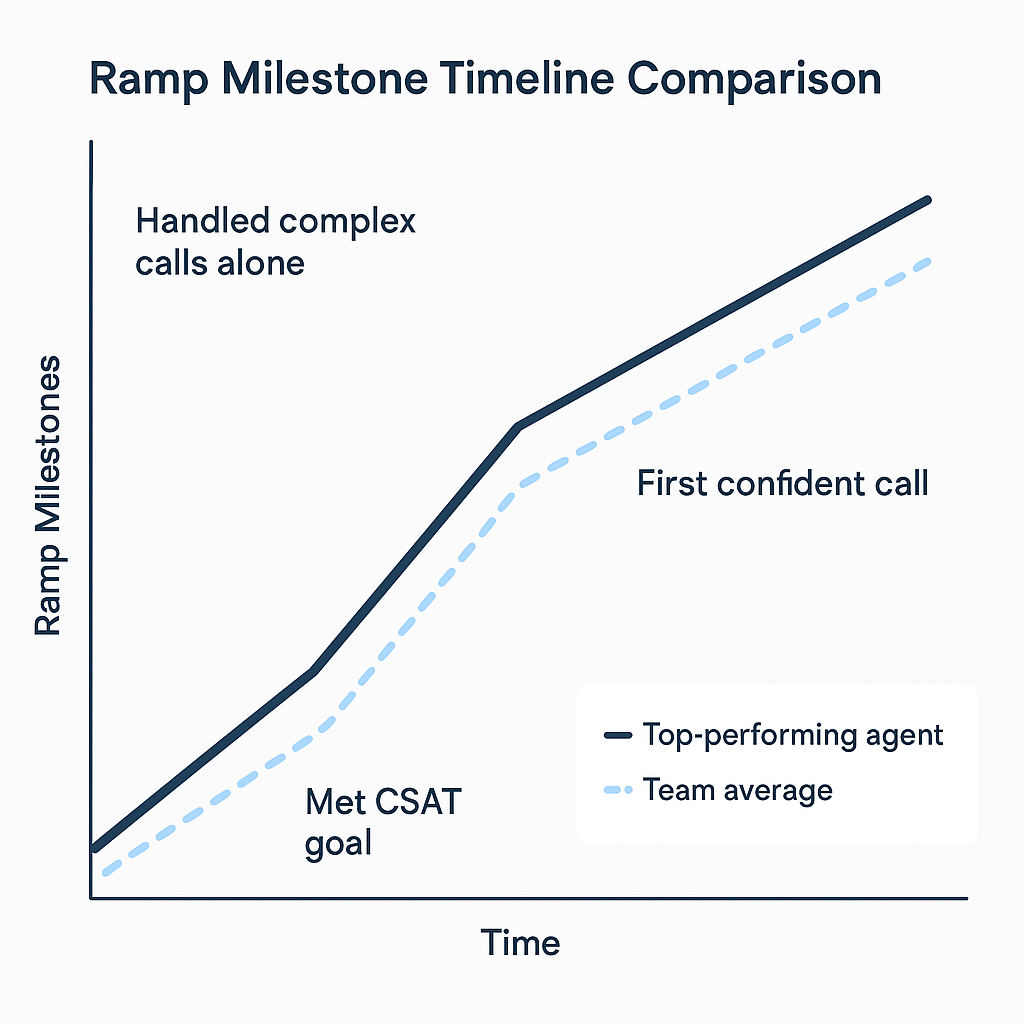
Instead, study your fastest-ramping agents and reverse-engineer their path. When did they become proficient? What practice helped them most? What milestones did they hit and when?
This approach lets you rebuild onboarding around outcomes — not activities.
Action Tip:
Track your top performers’ onboarding journey across three milestones:
Time to confident first call
Time to hit CSAT / QA targets
Time to independent handling of complex scenarios
Use those patterns to redesign your onboarding flow around results, not just schedules.
5. Shift from “One and Done” to Ongoing Micro-Coaching
Most agents regress after onboarding if they don’t get regular coaching. But teams are often too busy to keep supporting new hires beyond week one.
That’s where micro-coaching comes in. By pushing small, targeted refreshers based on real call data, you can keep agents sharp without adding to your team’s workload.
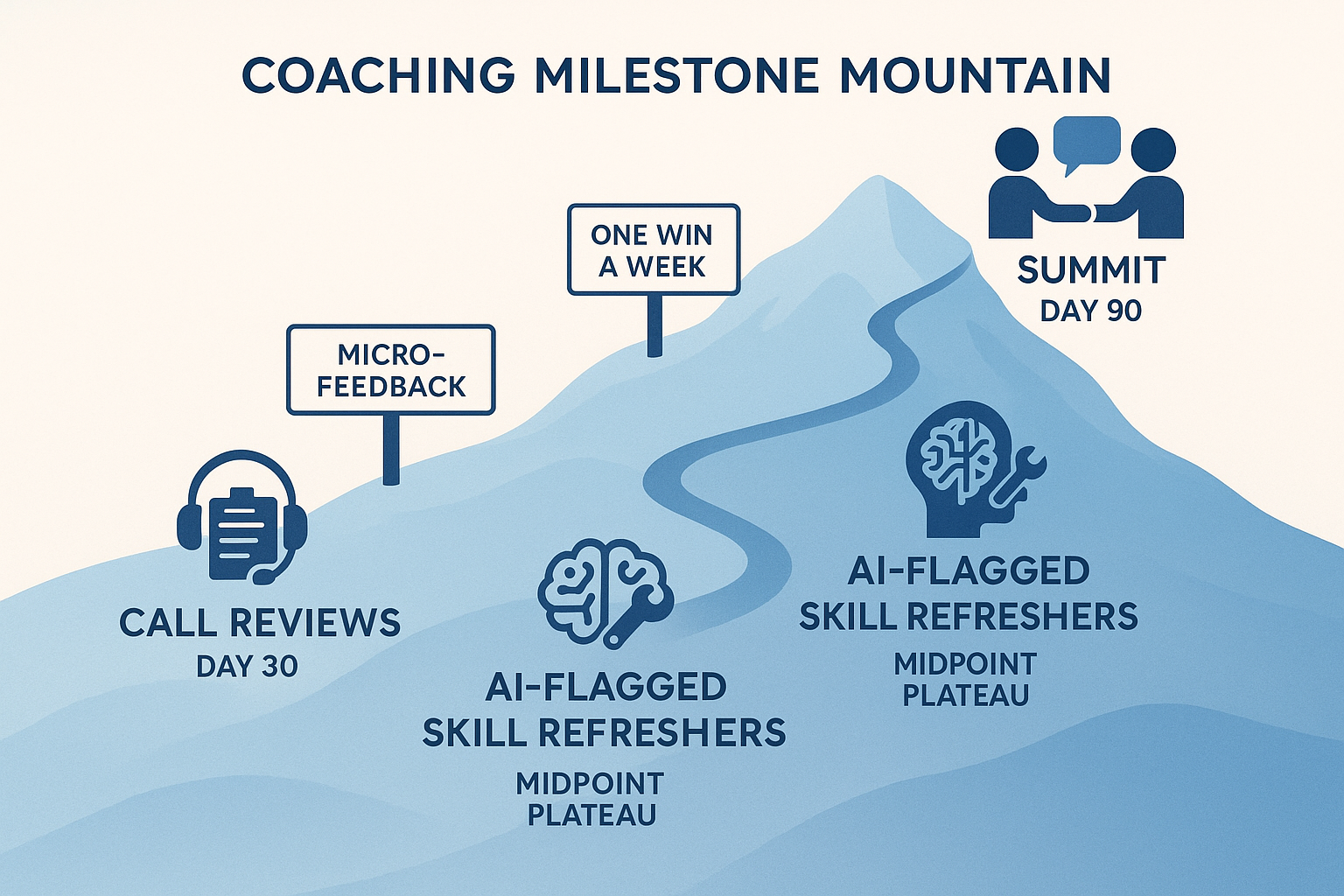
A visual metaphor for a 90-day coaching journey, with milestones marked along a rising mountain path: Call Reviews (Day 30), AI-Flagged Skill Refreshers (Day 60), and Peer Coaching (Day 90).
Action Tip:
Create a 30/60/90 day plan that combines live call reviews with 5–10 minute refreshers. Use AI to flag skill gaps and trigger the right micro-lesson. Consider peer coaching too — it boosts engagement and reinforces best practices.
Call Center Onboarding Optimization Checklist
Here’s your quick-start reference for streamlining onboarding without sacrificing quality.
Agent Evaluation (Week 1)
☐ Score every agent on coachability using mock or simulated calls ☐ Use a rubric: tone, product accuracy, objection handling ☐ Tag high-potential agents for fast-tracking ☐ Part ways early with non-coachable hires
Performance Benchmarks
☐ Set QA, CSAT, and AHT targets for day 1, week 1, and month 1 ☐ Use simulated environments to pre-test before live calls ☐ Track new-hire performance in a shared dashboard
Training Program Design
☐ Focus on practice and feedback over slide-heavy sessions ☐ Use AI-driven simulations instead of manual roleplays ☐ End each module with a pass/fail assessment or mock scenario
AI & Automation Integration
☐ Deploy Intelligent Virtual Customers for scalable mock calls ☐ Automate scoring and feedback to free up coaches ☐ Use performance data to trigger just-in-time coaching
Ongoing Reinforcement
☐ Build a 30/60/90 day roadmap with checkpoints and refreshers ☐ Push short, targeted lessons based on call performance ☐ Enable peer reviews and shared call feedback
Final Thoughts: Onboarding Doesn’t Have to Be a Bottleneck
Modern onboarding doesn’t have to mean slowing down operations or risking the customer experience.
Training lives in the back office. That’s where innovation can thrive — and where AI can safely support your team.
If you’re ready to reduce ramp time while giving your agents more practice, more feedback, and a smoother path to proficiency, TrueCX can help.
Explore how TrueCX’s Intelligent Virtual Customers enable faster, smarter onboarding — without slowing down your floor.